1413 Middle Huaihai Road
Former Hongying Library · Xuhui Art Museum
鸿英图书馆旧址 · 徐汇艺术馆
Books, classrooms and an art museum
The red-brick house at No. 1413 links a library, art education and public exhibitions. It brings the avenue’s cultural history to an intimate architectural scale.
Explore the historical timeline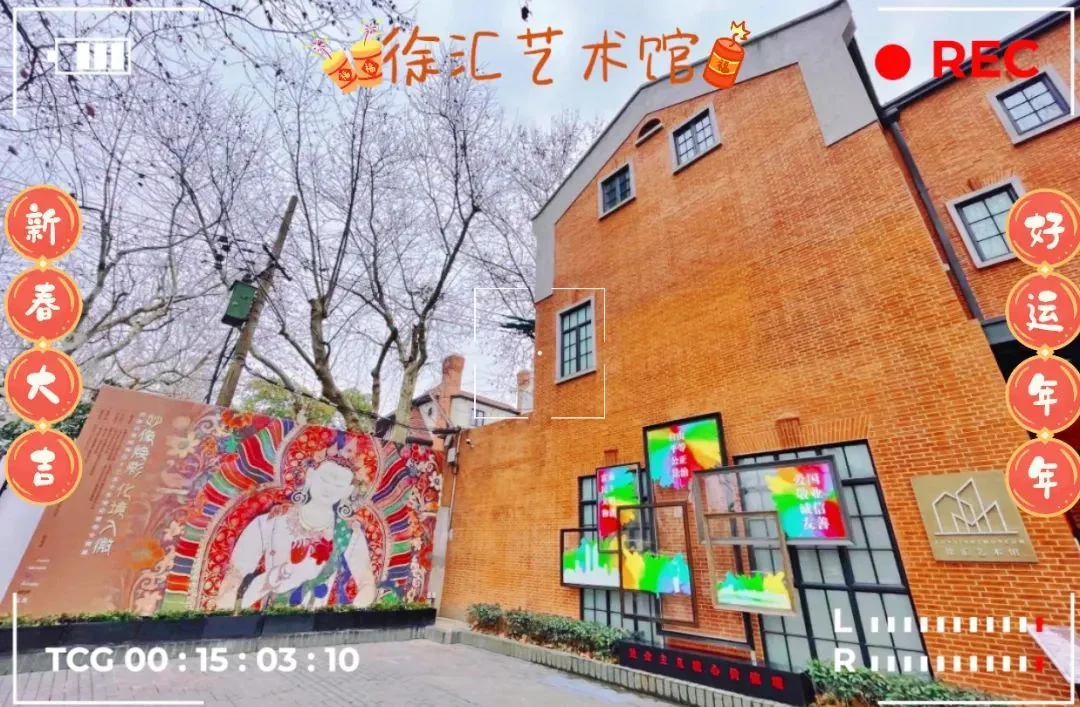
Published February 2022; capture date unstated
Xuhui Art Museum’s red-brick exterior. Festive and video-frame graphics belong to the source image, not the architecture.
Photographer uncredited; see source page · Image source · Rights retained by creators and source; no open licence stated
At a glance
- Building date
- Library established in 1933
- Designer
- Not established by the consulted records
- Character
- Red brick and steep gable
- Original use
- Hongying Library
- Recorded use
- Xuhui Art Museum, as documented
- Location
- 1413 Middle Huaihai Road
The people behind the address
A life in brief
Huang Yanpei (1878–1965) was an educator who connected schooling with working life; industrialist Ye Hongying funded this library. They were initiator and donor, not verified residents here.[1] [2]
Contributions and influence
Huang helped found the Chinese Vocational Education Association in 1917, connecting study, livelihood and service. Hongying Library translated educational ideals and private giving into public cultural space.[1] [2]
The beginning
Why was it built here?
Huang Yanpei initiated the library, funded by Ye Hongying, in 1933. Public knowledge was central to its early history, not merely a later use.[1] [2]
Art teaching and exhibitions continued its cultural role. Readers, students and visitors succeeded one another in a modestly scaled building.[1] [2]
Look up, then look closer
Three details worth a closer look
One building, changing roles
Read the building through time
Captions distinguish photographic dates from publication dates; periods without reliable images are covered in the text.
- 1933
- 1959
- 2022
Today and visiting
Discover the building from the street
Plan around the museum’s current exhibition notices. Historical uses are documented, but old exhibition titles and opening hours are not today’s programme.[1] [2]
- Location
- 淮海中路1413号
- Where to look
- Red brick and steep gable
- Access
- Check the venue’s current admission, booking and exhibition notices.
Sources checked: 2026-10-26 · Check the venue’s current admission, booking and exhibition notices.
Shanghai and the world
Connections along the avenue
Books, teaching and art are successive ways of providing public culture. Continue to Shanghai Library to compare knowledge spaces at two very different scales.[1] [2]
Text and image sources
This account is based on the sources below. Unverified details are identified as such. Where photographs are included, sources and licences are listed beneath each image.
- Shanghai municipal tourism information · Xuhui Art Museum (2022) ↗
Building and historical record; not a guarantee of access today.
- Shenzhen United Front Department · Huang Yanpei and vocational education ↗
Building and historical record; not a guarantee of access today.
Image handling and dating
Images come from the archives or image source pages listed beneath each photograph. We resize and compress them to WebP, preserving their original proportions without colourisation or added detail. Grain, blur and scanning marks in historical photographs are retained.
Undated photographs carry the source publication date only; they do not establish present access. Missing historical stages are not illustrated with another building or an imagined scene.
Rights retained by creators and source; no open licence stated