99 Wukang Road
The house at No. 99
武康路99号住宅
A garden house through changing institutional uses
99 Wukang Road. Built in 1928, No. 99 first housed a manager of the British Aquarius company. Its garden, wall and setback distinguish it from apartments built at the pavement edge; the roof silhouette may be easier to recognise than the complete façade.
Explore the historical timeline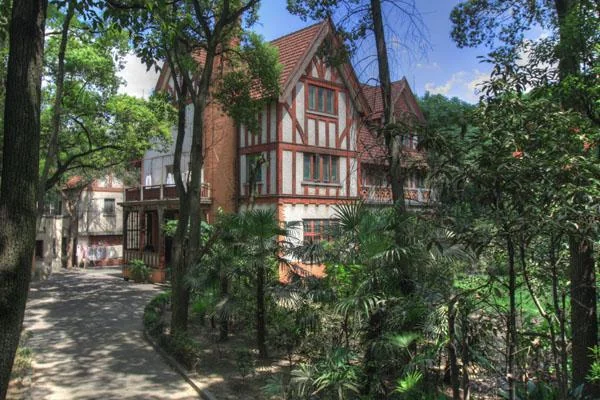
Published 2019-02-02; photograph undated
The house in the garden at 99 Wukang Road, with steep roofs and red timber detailing on its gables.
上观新闻(资料图片) · Image source · © 原权利人
At a glance
- Built
- 1928See the account and sources below
- Architect
- Not identified in the checked sourcesSee the account and sources below
- Architecture
- English country-house characterSee the account and sources below
- Original use
- Home of an Aquarius company managerSee the account and sources below
- Use today
- Later institutional offices; today’s use unverifiedSee the account and sources below
- Address
- 99 Wukang RoadSee the account and sources below
Architecture and use: sources[1]
The beginning
Why was it built here?
Built in 1928, No. 99 first housed a manager of the British Aquarius company. Its garden, wall and setback distinguish it from apartments built at the pavement edge; the roof silhouette may be easier to recognise than the complete façade.[1]
The Shanghai Vocal Music Research Institute moved here in 1960. Later uses included a guesthouse and institutional offices. Its history concerns the adaptation of domestic space to working and reception needs as much as individual residents.[1]
Look up, then look closer
Three details worth a closer look
Steep red roof
A steep red-tiled roof is a documented identifying feature, visible at a different level from the boundary wall.[1]
Tall chimneys
Chimneys sharpen the roofline and relate to domestic fireplaces; they are not simply decorative towers.[1]
Red and white through trees
The red-and-white house appears between mature trees; partial views are an intrinsic part of its street setting.[1]
One building, changing roles
Read the building through time
Captions distinguish photographic dates from publication dates; periods without reliable images are covered in the text.
- 1928
Private house completed
The original use was housing for an Aquarius company manager.[1]
- 1960
A music institution arrives
The Vocal Music Research Institute introduced office use into the former domestic setting.[1]
- Later years
Guesthouse and offices
The source records municipal guesthouse and East China communications-office uses without individual date ranges.[1]
Today and visiting
Discover the building from the street
Look for the roofline from public pavement near Fuxing West Road.[1]
- What to look for
- Identify red tiles, chimneys and wall colours through trees, taking care not to confuse neighbouring houses.
- Visiting
- No public exhibition access is confirmed; avoid photographing into private windows.
Sources checked: 2026-10-22 · Check current notices for access and business hours. A historical account of use is not confirmation of today’s operating status.
Shanghai and the world
Part of Wukang Road’s lived history
This address connects commercial and cultural institutional life. Some transitions are precisely dated and others are not; that distinction is retained here.[1]
Compare Lane 100’s hotel reuse with this house behind a high wall. Similar residential origins do not mean equal public access.[1]
Text and image sources
This account is based on the sources below. Unverified details are identified as such. Where photographs are included, sources and licences are listed beneath each image.
- Shanghai Civil Affairs Bureau · A walk along Wukang Road ↗
A 2023 account; descriptions of use refer to the period of that article.
Image handling and dating
Images come from the archives or image source pages listed beneath each photograph. We resize and compress them to WebP, preserving their original proportions without colourisation or added detail. Grain, blur and scanning marks in historical photographs are retained.
Images retain their original framing and proportions. Publication dates are not capture dates; unknown photograph dates are not inferred. Details, group views and architectural drawings are identified in the captions.