Third floor, No. 1, Lane 391, Wukang Road
Zhou Xuan’s former home
周璇旧居
A singer’s address on the third floor of Lane 391
Locate Zhou Xuan’s Shanghai home of 1943–1946 and distinguish a performer’s life, the house itself and today’s film district.
Explore the historical timeline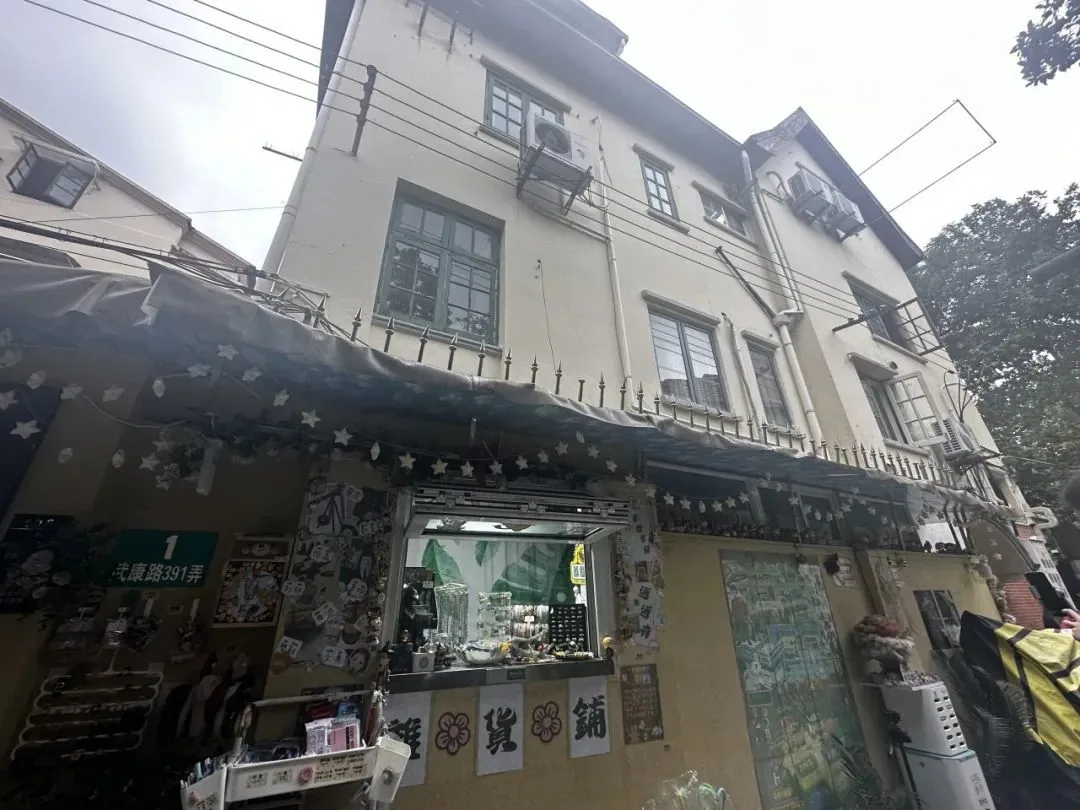
Published 6 October 2023; photograph date unspecified
The Lane 391 house containing Zhou Xuan’s former home, above a small shop. The report identifies her home on the third floor.
话匣子 / Huaxiazi (publisher) · Image source · © Huaxiazi / original photographer
At a glance
- Built
- Construction date unconfirmedHer arrival in 1943 is a life event, not a building date
- Architect
- Not documentedThe checked sources do not identify a designer
- Architectural character
- Three-storey residenceNo unverified style label assigned
- Original use
- HousingThe house’s origin is not dated by her arrival
- Present use
- Residential address and film-memory siteNot treated as a publicly accessible house museum
- Address
- Third floor, No. 1, Lane 391, Wukang RoadNot No. 390 Wukang Road
The people behind the address
A life in brief
Zhou Xuan (1920–1957) was a singer and film actress known as the “Golden Voice”. She joined the Bright Moon troupe in 1931 and rose to prominence in Street Angel (1937), later working in Hong Kong as well. Her Lane 391 home gives a domestic address to that public career.[4] [5]
Contributions and influence
Her performances of “The Wandering Songstress” and “Song of the Four Seasons” in Street Angel joined song to character and story, becoming classics of Chinese sound cinema and popular music. Her Shanghai–Hong Kong career also reflects exchanges between the two cities’ film and Mandarin-song cultures.[4] [5]
The beginning
Why was it built here?
Zhou Xuan’s screen image often brings songs to mind; this address returns attention to everyday living. She moved to the third floor of No. 1, Lane 391 in 1943 and left for film work in Hong Kong in 1946. It represents one documented chapter, not all of her homes in Shanghai.[1] [2] [3]
A lane address helps locate the house more reliably than celebrity anecdotes. Lane 391, the villa at No. 390 and Huang Xing’s No. 393 belong to different histories. The 2025 film-district renewal included Zhou Xuan’s doorway: a commemorative layer entered the streetscape while residential boundaries remained relevant.[1] [2] [3]
Look up, then look closer
Three details worth a closer look
One building, changing roles
Read the building through time
Captions distinguish photographic dates from publication dates; periods without reliable images are covered in the text.
- 1943
- 1946
- 2025
Today and visiting
Discover the building from the street
Identify Lane 391 from the public pavement and use the documentary account to understand the third-floor address.[1] [2] [3]
- What to notice
- Distinguish lane number, building number and floor. Film signs can help locate a site but cannot establish its historical date.
- Access
- Residential lanes and stairs are not assumed visitor routes. Avoid residents’ doors, interior photography and blocking the entrance.
Sources checked: 2026-10-22 · Documentary research does not verify access on the day. Follow posted notices and the property manager’s permission.
Shanghai and the world
This address within its neighbourhood
Zhou Xuan’s home and the actors’ troupe at No. 395 connect a personal residential history with an institutional workplace. Together they show how film culture enters everyday streets.[1] [2] [3]
Continue towards Wukang Mansion to compare more film-related residential histories without assigning every actor’s home to the famous pointed building.[1] [2] [3]
Text and image sources
This account is based on the sources below. Unverified details are identified as such. Where photographs are included, sources and licences are listed beneath each image.
- Shanghai Civil Affairs Bureau · Walking Wukang Road ↗
The 2023 account identifies Zhou Xuan’s home as the third floor of No. 1, Lane 391. Anecdotes are not used as architectural evidence.
- Guizhou CPPCC · Film memories of Wukang Road ↗
Official republication of Shen Lu’s 2023 article: arrival in 1943 and departure for Hong Kong in 1946. It does not establish the construction date or architect.
- Shanghai Municipal Government · Wutong Yingxiang film district ↗
The 28 October 2025 report links the troupe at No. 395 and Zhou Xuan’s doorway to the film district renewal. Project dates are not building dates.
- Hong Kong Film Archive · Zhou Xuan retrospective ↗
The people behind the address
- China Writers · Zhou Xuan and two cinema cities ↗
The people behind the address
Image handling and dating
Images come from the archives or image source pages listed beneath each photograph. We resize and compress them to WebP, preserving their original proportions without colourisation or added detail. Grain, blur and scanning marks in historical photographs are retained.
Images retain their original framing and proportions. Publication dates are not capture dates; unknown photograph dates are not inferred. Details, group views and architectural drawings are identified in the captions.