No. 1, the Bund · Zhongshan East First Road
Asia Building
亚细亚大楼
At the start of the Bund, from oil trading to art
From a rental property built for McBain to offices of the Asiatic Petroleum Company and today’s arts centre, No. 1 Bund connects a street corner with the wider world.
Follow its history through photographs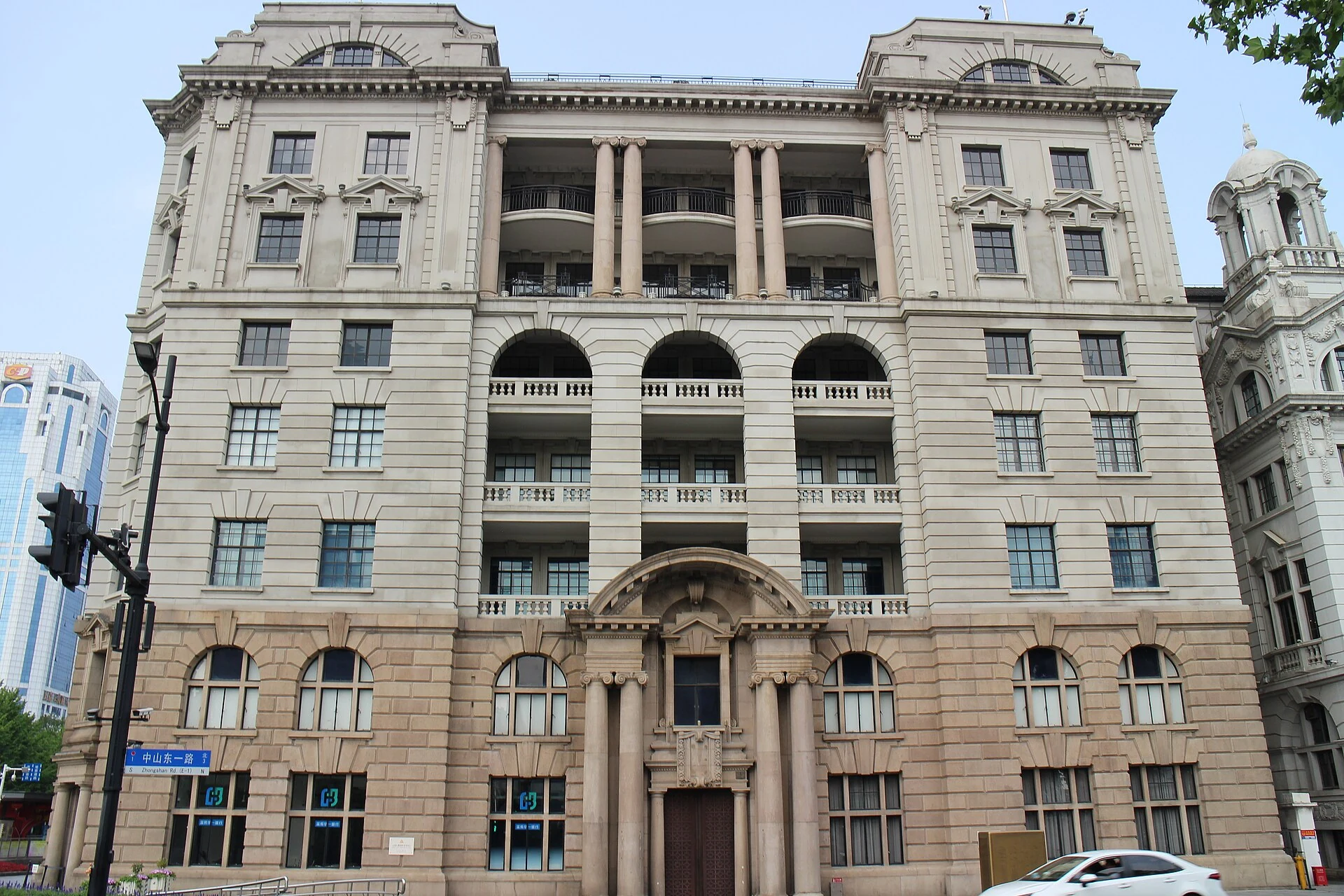
1 May 2025
The river façade of the Asia Building. Its central recessed balconies, flanking window rows and added top floor together form its present appearance.
Suicasmo · Image source · CC0 1.0
At a glance
- Construction / completion
- 1913 / 1916Surviving building; top floor added in 1938
- Architect
- Moorhead & HalseMoorhead & Halse
- Style
- EclecticStonework, colonnades and recessed balconies
- Original use
- Offices to letAsiatic Petroleum became the principal tenant in 1917
- Current use
- Jiushi International Art CentreThe new Jiushi Art Museum moved into floors 2 and 3 in 2026
- Location
- 1 Zhongshan East 1st RoadYan’an East Road junction · southern end of the Bund
Architecture and use: sources[1]
The beginning
Why was it built here?
The Asia Building takes its name from a tenant. McBain built it as a rental property; after the Asiatic Petroleum Company moved in in 1917, the tenant’s name gradually eclipsed the owner’s. There were no oil tanks or refineries here, but the offices formed a node in an international petroleum trading network.[1]
Its position also mattered: the Huangpu River lies to the east, and the road on the former Yangjingbang Creek to the south. Visible from both directions, the building greets people approaching along the waterfront and marks the entrance to the Bund from the city.[1]
Look up, then look closer
Three details worth a closer look
A corner drawn inward
Seen from Yan’an East Road, the southeast corner retreats inward. The stone walls meet in this recess, giving the junction more space and joining the river and street façades into one composition.[1]
Balconies open up the heavy façade
Stacked central balconies set columns against deep shadows. Compared with the flat rows of windows on either side, this opening makes the office building feel less enclosed.[1]
Find the extra floor in an old photograph
The roofline in the photograph published in 1927 differs from today’s. An additional floor raised the building in 1938. Compare cornices and pediments first, rather than treating every floor as part of the 1916 original.[1]
One building, changing roles
History unfolds between the photographs
From earlier buildings to the one standing today. Captions distinguish photographic dates from publication dates; periods without reliable images are covered in the text.
- 1913–1916
A rental building rises at the corner
Financed by McBain and designed by Moorhead & Halse, the new building gave the southern end of the Bund a distinctive corner façade.[1]
- 1917
The petroleum company leaves its name
Asiatic Petroleum rented most of the floors. The change of name shows how a long-term occupier can shape a building’s place in urban memory.[1]
- Published in 1927
No. 1 Bund before its extension
This plate preserves the pre-extension outline together with vehicles and pedestrians in the street. The publication year is established; the exact date of photography is unknown.
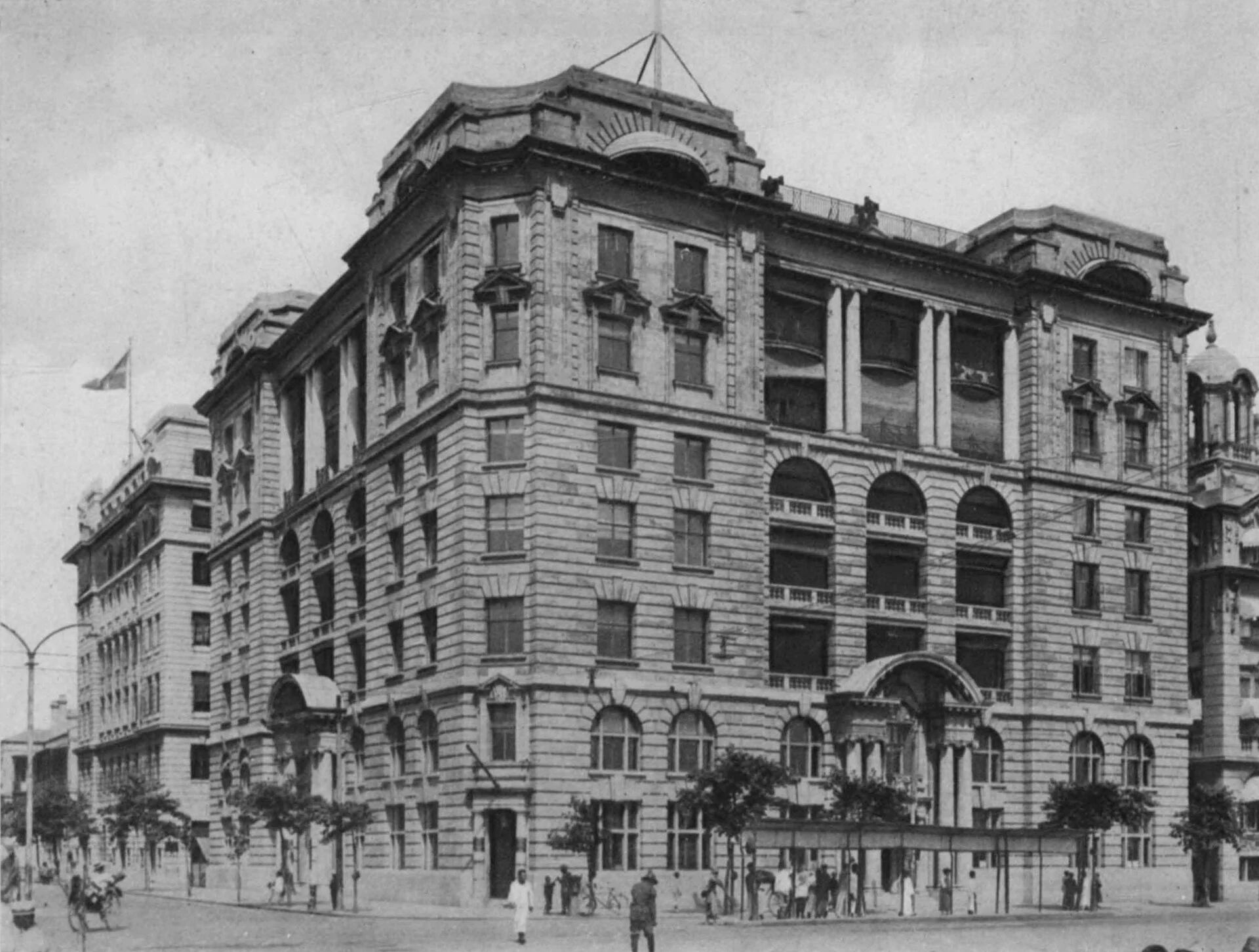
Published in 1927 · photograph date unknown
Plate 5 of Shanghai of Today shows the Asia Building and junction before the 1938 addition.
Photographer unknown; published by A. S. Watson & Co. · Image source · Public domain
- 1938
An additional floor above the roof
An eighth floor was added. The building’s present mass includes later expansion and cannot simply be read back into photographs of the 1920s.[1]
- Second half of the 20th century
From petroleum to institutional offices
Petroleum, design and other organisations successively used the building. Following a property exchange in the 1990s, it also housed the headquarters of China Pacific Insurance.[1]
- 2019–2022
An arts centre and auction spaces arrive
Jiushi International Art Centre opened, followed by Christie’s. The former office building began accommodating exhibitions and art sales.[1]
- 2026
The new Jiushi Art Museum opens
The new museum opened on floors 2 and 3 on 31 March. This change of address brought the former oil company offices into another phase of the city’s public cultural life.[2]
Today and visiting
Discover the building from the street
Read both façades from the junction before visiting the art spaces according to their current programme.[2]
- The corner
- Compare the recessed corner, balconies and added top floor from Yan’an East Road.
- Exhibitions
- Jiushi Art Museum has moved to No. 1 Bund. Consult the venue’s current announcements for dates, tickets and entrances.
Sources checked: 2026-10-19 · The closing date of the first exhibition in spring 2026 does not describe today’s programme; this page does not reuse outdated exhibition hours.
Shanghai and the world
One street, two kinds of everyday life
The Shanghai Club to the north served social life, while this building served corporate offices. Trade in the same city needed both businesses and places to meet and maintain connections.[1]
Text and image sources
This article reorganizes the sources below. Text adapted and condensed from Wikipedia, including its translations here, is provided under CC BY-SA 4.0; the original contributors are listed in the article’s revision history. Image licences are listed separately beneath each photograph.
- Wikipedia · Asia Building, Shanghai ↗
Used to cross-check the building’s history; conflicting dates are identified in the text. The article was independently written for this site; photographic credits and licences are listed separately.
- Meet in Shanghai · No. 1 Bund reopens ↗
Published on 5 April 2026; confirms the new Jiushi Art Museum opened on 31 March and identifies its floors.
Image handling and dating
Images come from the archives or image source pages listed beneath each photograph. We resize and compress them to WebP, preserving their original proportions without colourisation or added detail. Grain, blur and scanning marks in historical photographs are retained.
The historic photograph retains its original monochrome tones and has not been colourised; 1927 is its publication year.
The exterior photograph dates from 2025, before the new museum opened in 2026.