149 Yuanmingyuan Road
Somekh Building
哈密大楼
A city read through its newsroom windows
Somekh’s story extends beyond its façade. A Wenhui contributor recalls carrying proofs and visiting night editors at 149 Yuanmingyuan Road. Newspaper history becomes a working routine located behind a particular doorway.
Explore the historical timeline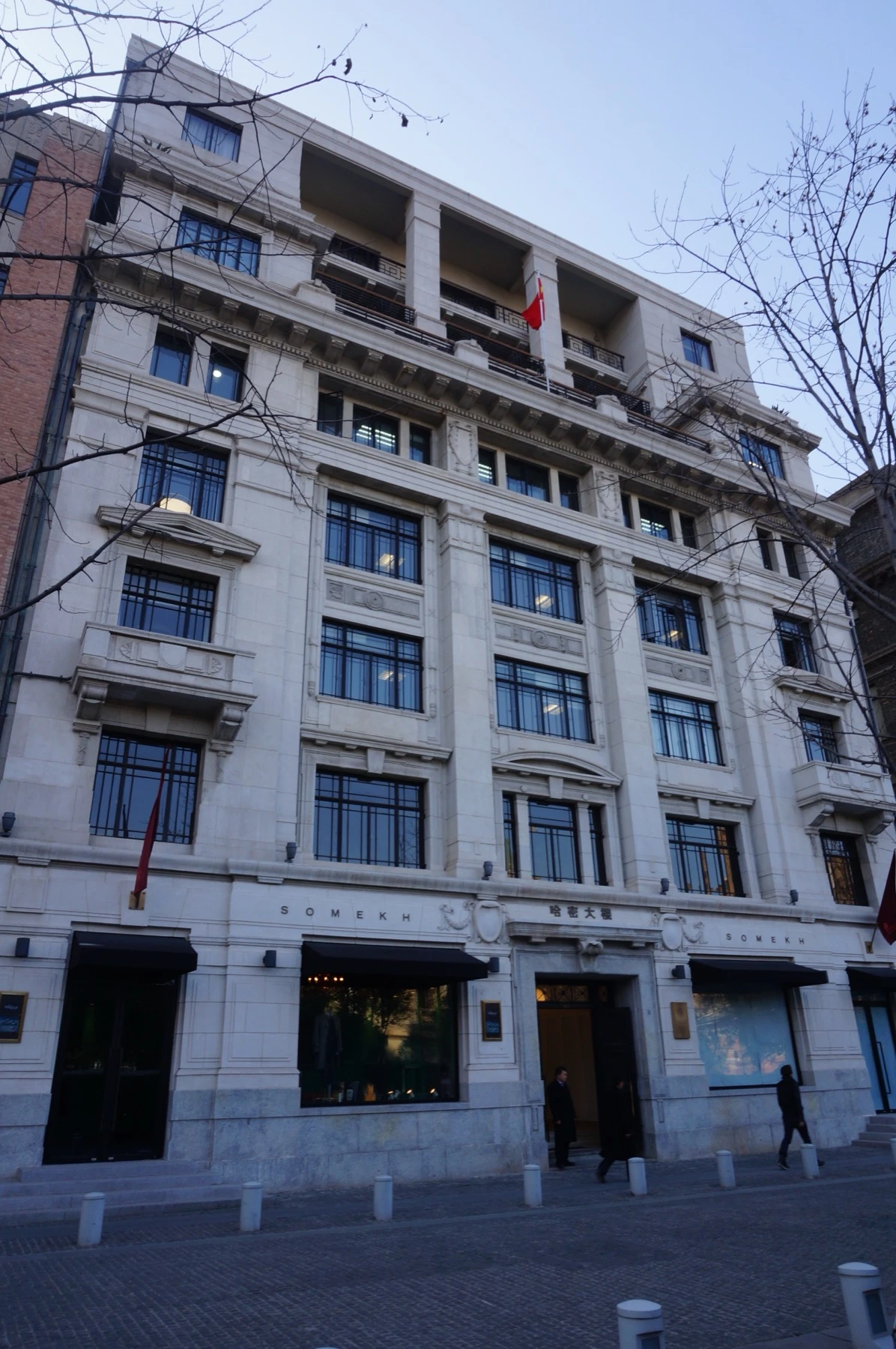
2014-01-27
Somekh frontage on 27 January 2014, identified by the SOMEKH lettering above the entrance.
Livelikerw · Image source · CC BY-SA 3.0
At a glance
- Dates
- 1927
- Designer
- Moorhead & Halse
- Architecture
- Neoclassical eclecticism
- Historical use
- Offices; later a Wenhui newspaper officeHistoric names are not a current tenant directory
- Present context
- ROCKBUND district; interior access follows venue arrangements
- Address
- 149 Yuanmingyuan Road
The beginning
Why was it built here?
Somekh’s story extends beyond its façade. A Wenhui contributor recalls carrying proofs and visiting night editors at 149 Yuanmingyuan Road. Newspaper history becomes a working routine located behind a particular doorway.[1] [2]
Storey counts vary with additions and counting conventions; one number is not applied to every period. Newsroom memories do not imply a newsroom open to visitors today.[1] [2]
Look up, then look closer
Three details worth a closer look
Restoration as a new chapter of use
The architect distinguishes façade restoration from later completion of the wider project. Renewal also includes alleys and public spaces: the street and the block interior offer different scales of understanding.[3]
One building, changing roles
Read the building through time
Captions distinguish photographic dates from publication dates; periods without reliable images are covered in the text.
- 1927
- 2006–2023 · district renewal
Restoration as a new chapter of use
The architect distinguishes façade restoration from later completion of the wider project. Renewal also includes alleys and public spaces: the street and the block interior offer different scales of understanding. Wider project dates, not seventeen years of continuous work on this building[3]
- 2026-10-26
Today and visiting
Discover the building from the street
View façades from public pavements. Check signs before entering lobbies, courtyards and exhibitions; an open shop does not mean the entire building is accessible.[1] [2]
- Address
- 149 Yuanmingyuan Road
- Before entering
- Historical records explain changes of use, not today’s tenants, exhibitions or hours. Locate the address, then confirm current entry conditions.
- Continue walking
- Yuanmingyuan · Huqiu
Sources checked: 2026-10-26 · View façades from public pavements. Check signs before entering lobbies, courtyards and exhibitions; an open shop does not mean the entire building is accessible.
Shanghai and the world
Put the building back into its block
Read the three-part relationship of base, main body and cornice, then the concentration of detail at the door and balcony. Beside the YWCA’s colour and vertical lines, it shows that this street has no single architectural language.[1] [2]
Text and image sources
This account is based on the sources below. Unverified details are identified as such. Where photographs are included, sources and licences are listed beneath each image.
- Wenhui · Memories of the newspaper office (2016) ↗
A personal account of Somekh, its 1927 date and architectural firm; the illustration is not an archival photograph.
- Shanghai Huangpu inventory · People.cn republication (2022) ↗
Architectural details and date comparison; its 1930–1931 Lyceum dating differs from another record of 1927.
- David Chipperfield Architects · ROCKBUND ↗
Restoration, project phases and photographs; subjects are identified separately.
- Somekh Building · 2014 photograph ↗
Photographer’s own upload; capture date, credit and image licence retained. Only proportional resizing and WebP compression.
Image handling and dating
Images come from the archives or image source pages listed beneath each photograph. We resize and compress them to WebP, preserving their original proportions without colourisation or added detail. Grain, blur and scanning marks in historical photographs are retained.
Photographs retain source attribution and their original framing; dates are not inferred. Paired comparisons are shown intact, without relabelling one side as another period.
Photographer’s own upload; capture date, credit and image licence retained. Only proportional resizing and WebP compression.
No securely identified historical photograph of this building is included; neighbouring buildings are not substitutes.