20 Huqiu Road, Huangpu, Shanghai
Royal Asiatic Society Building
亚洲文会大楼
From a museum and library to contemporary art
At 20 Huqiu Road, scholarship, collecting and contemporary art meet. A 1941 library photograph and views before and after restoration reveal how the building changed its purpose while remaining connected to Shanghai.
Follow its history through photographs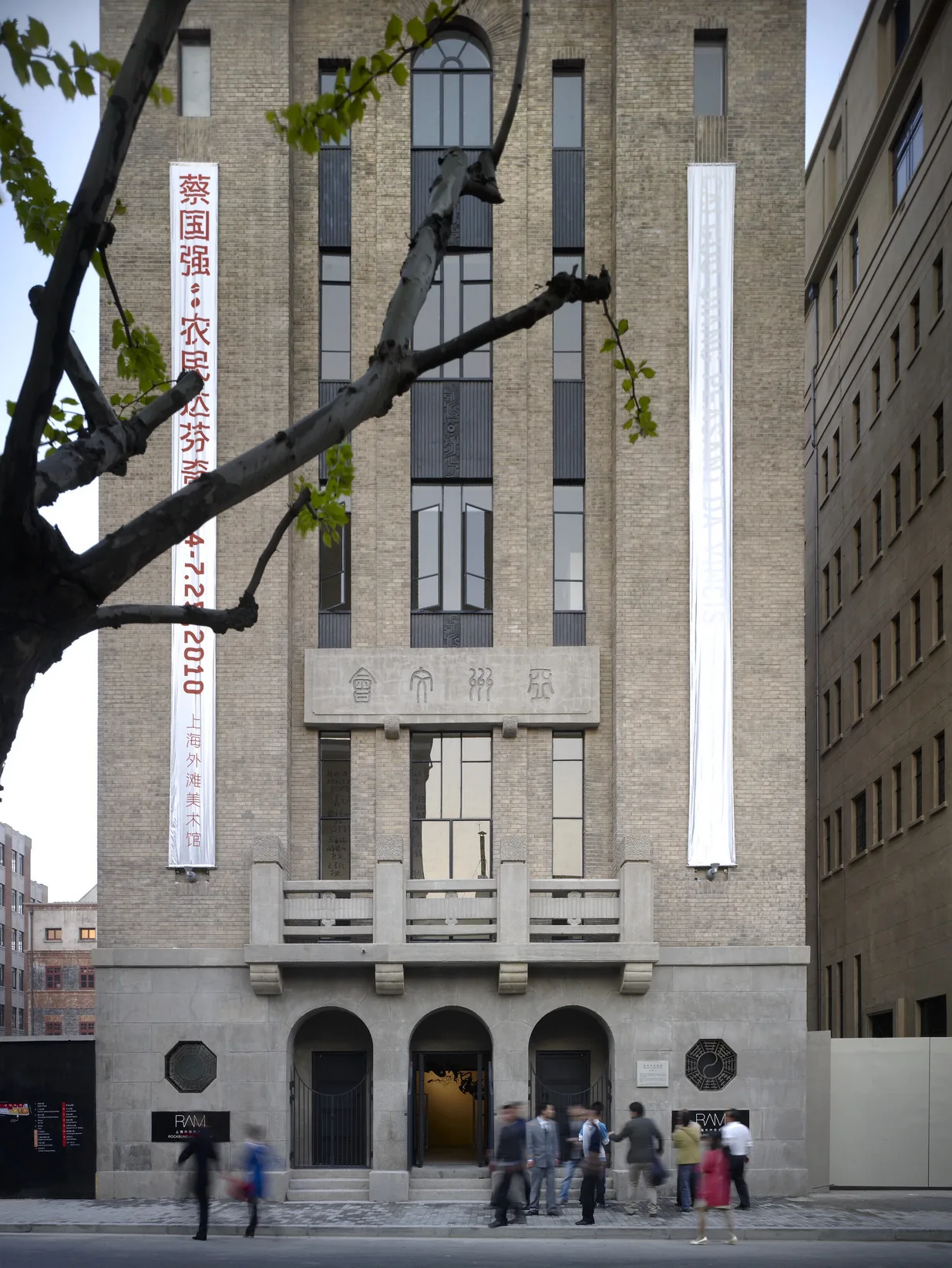
2010 exhibition period
The restored RAS building during the museum’s early exhibition period; banners refer to a past event.
Christian Richters / David Chipperfield Architects · Image source · Rights retained by original creators and source
At a glance
- Built
- Completed 1932; opened 1933Present building; earlier premises have a separate history
- Architect
- George L. WilsonPalmer & Turner
- Style
- Art DecoChinese and Western decorative elements
- Original use
- Museum, library and lecture hallNorth China Branch of the Royal Asiatic Society
- Current use
- Rockbund Art MuseumContemporary art institution since 2010
- Address
- 20 Huqiu Road, Huangpu, ShanghaiHuqiu Road, formerly Museum Road
The beginning
Why was it built here?
The cultural life of this address predates the building now standing here. In the nineteenth century, the Society’s North China Branch established a library, museum and lecture space on the site. Its earlier premises were replaced: the institution’s age is not the age of the present building.[1]
The new building of the 1930s brought research and public education into an Art Deco setting. Unlike the bank halls on the Bund, its central subjects were books, specimens, exhibitions and lectures. It also invites a question today: who collected knowledge, and who could enter these cultural spaces?[1] [2]
Look up, then look closer
Three details worth a closer look
Read the vertical rhythm
From across Huqiu Road, slender windows and the stepped upper silhouette give the façade its upright rhythm. Follow the symmetry from entrance to roof, then compare this narrow frontage with the broader banks on the Bund.[1]
Look for Chinese details
The museum describes a combination of Chinese and Western elements. Examine the window shapes, balustrades and lettering around the entrance, then step back to read the proportions. Ornament and overall composition reward different viewing distances.[1]
One building, changing roles
History unfolds between the photographs
Captions distinguish photographic dates from publication dates; periods without reliable images are covered in the text.
- 19th century
A cultural institution before this building
The Society’s library, museum and lectures took root here. This is the history of the earlier premises, before the present building existed.[1]
- 1932–1933
- 1941
Scholarship between the shelves
A library photograph dated 1941 in the journal gives scholarship a physical setting of shelves and books. It records the collection indoors, not the building’s exterior.[2]
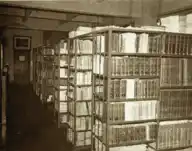
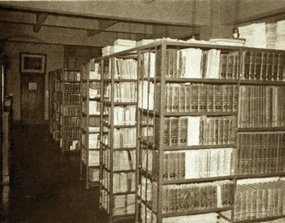
1941, journal caption
Historic shelving in the RAS Library. Journal p. 99, figure 1; an interior historical record, not a photograph of the collection’s present location.
Photographer uncredited · reproduced in Peter Hibbard / RAS China · Image source · Rights retained by original creators and source
- 1952
- January 2008
Huqiu Road before restoration
The pre-restoration photograph records vehicles, cables and everyday street life. Compare it with the 2010 view from the same side to see changes to the façade and its surroundings.[2]
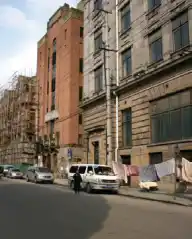
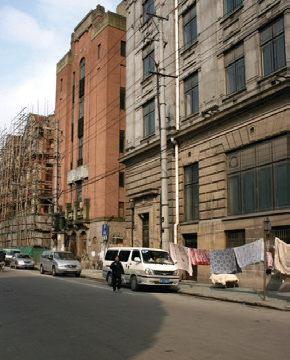
January 2008
Street view before restoration, with vehicles and cables. Journal p. 124, figure 11.
Photographer uncredited · reproduced in Peter Hibbard / RAS China · Image source · Rights retained by original creators and source
- 2010
Contemporary art enters the building
Rockbund Art Museum opened in 2010. The photograph is dated June 2010 and shows the restored façade. Exhibition signs in it belong to that period, not to the current programme.[1] [2]
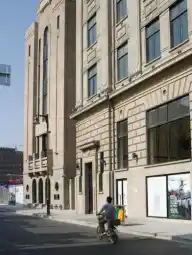
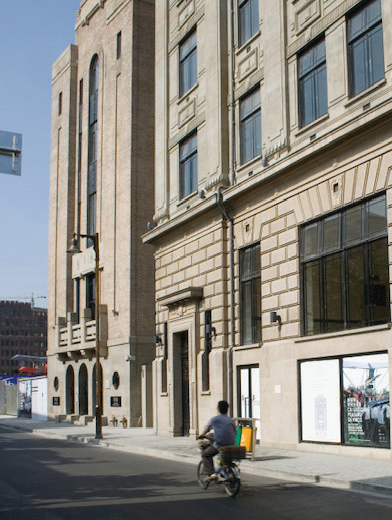
June 2010
Restored street frontage, comparable with the 2008 view. Journal p. 124, figure 12.
Photographer uncredited · reproduced in Peter Hibbard / RAS China · Image source · Rights retained by original creators and source
- 2023
A new entrance and Museum Plaza
The new entrance and Museum Plaza opened on 22 September 2023. Read the building through both its historic frontage and the public spaces that connect it to the surrounding block.[4]
Today and visiting
Discover the building from the street
Begin with the historic frontage from the Huqiu Road pavement, then follow signs to the museum entrance and plaza. Looking at the building and entering exhibitions are separate activities; gallery admission follows the museum’s current arrangements.[1] [5]
- Present use
- Rockbund Art Museum: contemporary art exhibitions, research and public programmes.
- Current notice
- Official notice: temporarily closed from 21 September to 30 October 2026 for exhibition preparation, with reopening planned for 31 October. Check the museum before travelling.
- Continue the walk
- Continue along Huqiu Road to the publishing and theatre sites, then connect to Yuanmingyuan Road via Hong Kong Road or South Suzhou Road.
Sources checked: 2026-10-26 · Admission arrangements follow the museum’s latest notices.
Shanghai and the world
How knowledge, collections and art cross borders
The Society left a history of scholarly networks and collections; RAM works with artists, audiences and the city today. These are not simply one continuous institution, yet the same address repeatedly becomes a place of cultural exchange. In the context of concession-era and modern Shanghai, exchange, power and public education belong in the same conversation.[1] [2]
Text and image sources
This article reorganizes the sources below. Text adapted and condensed from Wikipedia, including its translations here, is provided under CC BY-SA 4.0; the original contributors are listed in the article’s revision history. Image licences are listed separately beneath each photograph.
- Rockbund Art Museum · About and Building ↗
Architect, 1932 completion, original functions and present institution.
- Peter Hibbard · Journal of the RAS China, 2023 ↗
“Comings and Goings”: printed pp. 98–99 record the 1933 opening and 1941 library image; p. 124, figures 11–12, dates the exterior views to January 2008 and June 2010.
- David Chipperfield Architects · ROCKBUND ↗
Project record of restoration, galleries and atrium; source of the modern photograph.
- RAM · RAM assembles 2023: Public Space ↗
Confirms the new entrance and Museum Plaza opening on 22 September 2023.
- RAM · Notice of Temporary Closure ↗
Checked 26 October 2026: closed until 30 October, reopening planned for 31 October; recheck for future visits.
- Wikipedia · Rockbund Art Museum ↗
Cross-check for uses and collection transfers; 1932 and 1933 are distinguished using museum and journal records.
Image handling and dating
Images come from the archives or image source pages listed beneath each photograph. We resize and compress them to WebP, preserving their original proportions without colourisation or added detail. Grain, blur and scanning marks in historical photographs are retained.
The 1941, 2008 and 2010 images were extracted from the journal’s embedded photographs, without redrawing, colourisation or upscaling. Their limited original resolution is preserved through smaller display sizes. The captions do not individually identify photographers; the article’s author is not assumed to be the photographer.