Behind the Bund: follow brick façades, publishing houses and a museum through two neighbouring streets.
PATH 05 · BEHIND THE BUND
Two streets, one walk
Start at Beijing East Road and walk north along Yuanmingyuan Road. At South Suzhou Road, turn west, then return south along Huqiu Road. The streets run parallel; Hong Kong Road offers another connection.
Allow about 45–60 minutes with stops; longer for exhibitions. Building interiors and courtyards have their own access arrangements. Check the venue before visiting.
Walking diagram · not to scale
This guide focuses on Beijing East Road–South Suzhou Road. The protected Yuanmingyuan Road extends farther south to Dianchi Road; the listed Huqiu–Zhapu route also crosses the river.
Walking diagram · not to scale
North at top · South at bottom
Yuanmingyuan Road
Scroll along the street. Hover or select a building for its story.
Street zoom
Stretch view
Street illustration for exploring the façades; consult the source photographs and maps for on-site details.
Along this street
01 / 19C / 2023
Andrews & George Building
北京东路100—114号
The southern corner pairs an old brick frontage with a contemporary tower. Look at the change in brickwork: today’s outline combines different periods, rather than preserving a single historic height.
02 / 1907
Ampire Building
圆明园路97号
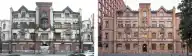
Built in 1907, this brick-and-timber building housed Ampire between 1941 and 1948. Its bay window, curved balconies and stone door surrounds reward a close look. Restoration brought the brickwork back into view.
03 / 1904
Yuanmingyuan Apartments
圆明园路115号
The paired gables and central arched window distinguish this lower building from its taller neighbours. The architect’s before-and-after record shows how the roofline was recovered during restoration.
04 / 1933
YWCA Building
圆明园路133号
Designed by Poy Gum Lee, the building combines an Art Deco outline with Chinese decorative details. Its history connects architecture with women’s education and social service. Notice the vertical bands and recessed upper floors.
05 / 1927
Somekh Building
圆明园路149号
This address belongs to Shanghai’s newspaper and literary history. Wen Hui Bao recalled Lu Xinhua’s 1978 visit here to discuss his story “Scar”, a landmark of the period. The pale façade contrasts with the adjacent YWCA.
06 / 1920s
Union Building
圆明园路169号
The broad frontage marks a different scale from the early houses farther south. Its name recalls Christian institutional networks. Compare its repeated window bays and strong horizontal cornices with the vertical rhythm of the YWCA.
07 / 1927
Lyceum Building
圆明园路185号
A small roof tower makes this façade easy to recognise. The Lyceum name belongs to the area’s theatre history; this is not the present Lyceum Theatre on Maoming South Road. Look for the contrast between brick and pale stone bands.
08 / 1930
True Light Building
圆明园路209号
At the northern end, red brick piers and decorative parapets give the building a strong vertical rhythm. Its publishing history links this frontage with the Kwang Hsueh building on the Huqiu Road side of the block.
Before & after restoration
Ampire Building before and after restoration. The historic photograph is undated in the published project record.
Huqiu Road
Follow Huqiu Road south from the river. Explore the theatre and publishing heritage, then finish at the former Royal Asiatic Society building. The photographs below show separate viewpoints, not a stitched panorama.
Street corners & courtyards
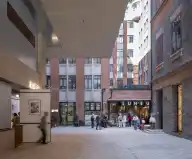
A courtyard within Rockbund, near the urban archaeology library. A separate viewpoint inside the block.
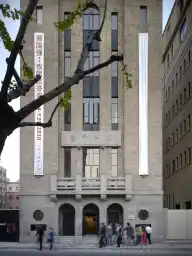
Royal Asiatic Society building · Rockbund Art Museum. Photograph from the restoration project; the exhibition banners are historical.
Along this street
09 / 1928
Capitol Building
虎丘路146号
Near the river and Zhapu Road Bridge, this building once combined a cinema below with offices and apartments above. It is a good starting point for following Huqiu Road’s cultural history southward.
10 / 1930s
Kwang Hsueh Building
虎丘路128号
A publishing address on the Huqiu Road side, connected with the True Light complex facing Yuanmingyuan Road. Comparing the two sides reveals how institutions occupied whole blocks rather than isolated façades.
11 / 2023
Urban Archaeology Library
虎丘路,兰心大楼旁
Look into the courtyards beside the Lyceum complex for a cultural space devoted to Shanghai’s urban history. The library and exhibitions connect street observation with photographs, archives and reading. Check access before entering.
12 / 1932 / 2010
Rockbund Art Museum
虎丘路20号
George L. Wilson designed the Royal Asiatic Society building in 1932. Its Art Deco form incorporates Chinese details. Reopened as Rockbund Art Museum in 2010, it carries the site’s museum history into contemporary art.