1380 Fuxing Middle Road
Shanghai Symphony Hall
上海交响乐团音乐厅
Contemporary hall with low curving roofs
Opened on 6 September 2014 as the orchestra’s new home, the venue combines a 1,200-seat main hall and a 400-seat chamber hall for different musical scales.
Explore the historical timeline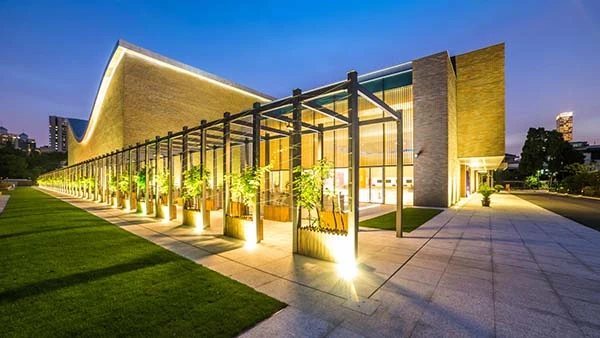
Capture date unstated; published 2014-09-06
Hall exterior in the 2014 opening report; capture date and photographer not separately stated.
The Paper field report: architecture and acoustics · Publishing institution; photographer not separately credited · Image source · Original source declares no open licence
At a glance
- Built
- Opened 6 September 2014
- Architect
- Arata Isozaki, architecture; Yasuhisa Toyota, acoustics
- Architecture
- Contemporary hall with low curving roofs
- Original use
- Orchestral performance and rehearsal
- Present use
- Shanghai Symphony Orchestra venue; admission follows event arrangements
- Address
- 1380 Fuxing Middle RoadFuxing Middle Road
The beginning
Why was it built here?
Opened on 6 September 2014 as the orchestra’s new home, the venue combines a 1,200-seat main hall and a 400-seat chamber hall for different musical scales.[1] [2] [3]
Architect Arata Isozaki and acoustician Yasuhisa Toyota coordinated space, materials and seating details. Proximity to the metro made vibration isolation a central engineering concern.[1] [2] [3]
Look up, then look closer
Details worth a closer look
One building, changing roles
Read the building through time
Captions distinguish photographic dates from publication dates; periods without reliable images are covered in the text.
- 2014-09-06
- 2014
- 2026
Today and visiting
Discover the building from the street
Shanghai Symphony Orchestra venue; admission follows event arrangements[1] [2] [3]
- Address
- 1380 Fuxing Middle Road
- Visiting
- Observe from public pavements; entry follows posted opening and booking rules. Respect residential, office and worship uses. A guide marker is not permission to enter.
Sources checked: 2026-10-26 · Observe from public pavements; entry follows posted opening and booking rules. Respect residential, office and worship uses. A guide marker is not permission to enter.
Shanghai and the world
Read history across the neighbourhood
Neighbouring apartments, houses and public spaces have different construction and use histories. Addresses, photograph directions and records together reveal how the neighbourhood developed.[1] [2] [3]
Text and image sources
This account is based on the sources below. Unverified details are identified as such. Where photographs are included, sources and licences are listed beneath each image.
- Ministry of Culture: hall opening in 2014 ↗
Compiled from the listed evidence. Publication, capture and construction dates are distinguished.
- The Paper field report: architecture and acoustics ↗
Compiled from the listed evidence. Publication, capture and construction dates are distinguished.
- Shanghai government: Xuhui cultural venues ↗
Compiled from the listed evidence. Publication, capture and construction dates are distinguished.
- The Paper field report: architecture and acoustics ↗
Original source declares no open licence
Image handling and dating
Images come from the archives or image source pages listed beneath each photograph. We resize and compress them to WebP, preserving their original proportions without colourisation or added detail. Grain, blur and scanning marks in historical photographs are retained.
Original framing is retained, with WebP conversion and previews only. Article dates do not replace unknown capture dates; drawings and photographs are identified separately.