4, Lane 76, Tai’an Road
He Luting’s Home in Yicun
贺绿汀旧居 · 亦村
A composer’s later life and a small garden
Yicun began with six houses and later expanded. No. 4 predates its famous resident: He Luting moved here in 1956 and lived here until his death in 1999.
Explore the historical timeline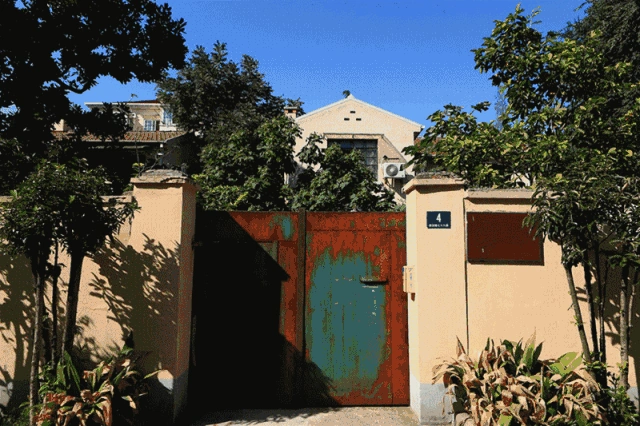
Capture date not stated by the source
Yicun No. 4 entrance and roof behind trees; unchanged fourth frame of the source animation.
Image from the cited report or institutional source · Image source · Rights retained by the original creator
At a glance
- Construction / use dates
- This house 1934; ensemble expanded through 1948
- Architect
- Qian Xiangshou architectural practice (Yicun)
- Character
- Modern detached garden house
- Original use
- Garden residence
- Use and access
- Residence; sources list no public access
- Address
- 4, Lane 76, Tai’an Road
The people behind the address
A life in brief
He Luting (1903–1999) was a composer, music educator and long-serving head of the Shanghai Conservatory.[1] [2] [3] [4]
Contributions and influence
The piano piece The Cowherd’s Flute and the song Guerrillas’ Song span art music and collective singing. His teaching passed that experience to successive generations.[1] [2] [3] [4]
The beginning
Why was it built here?
Yicun began with six houses and later expanded. No. 4 predates its famous resident: He Luting moved here in 1956 and lived here until his death in 1999.[1] [2] [3] [4]
The house accommodated composition, visitors and family life. Yicun was listed in 1999. This is distinct from his earlier home in Meihuali on Anfu Road; the addresses and periods should remain separate.[1] [2] [3] [4]
Look up, then look closer
Details worth a closer look
Capture date not stated by the source
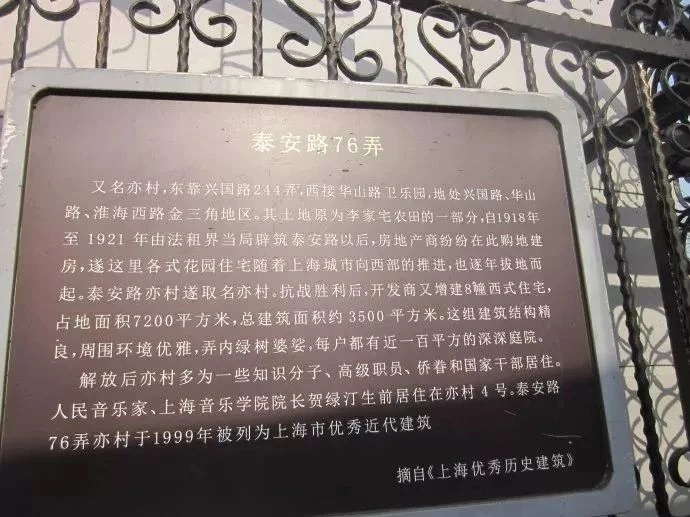
Historic-building plaque for Yicun at Lane 76, recording the ensemble and He Luting’s residence.
Image from the cited report or institutional source · Image source · Rights retained by the original creator
One building, changing roles
Read the building through time
Captions distinguish photographic dates from publication dates; periods without reliable images are covered in the text.
- 1934
- 1956–1999
- 1999
Today and visiting
Discover the building from the street
Residence; sources list no public access[1] [2] [3] [4]
- Address
- 4, Lane 76, Tai’an Road
- Access
- View from public roads and permitted areas. Historic importance does not open residential gardens, stairs or institutional compounds to the public; follow posted access rules.
Sources checked: 2026-10-26 · View from public roads and permitted areas. Historic importance does not open residential gardens, stairs or institutional compounds to the public; follow posted access rules.
Shanghai and the world
Building and neighbourhood
Music, theatre and scholarship meet along Tai’an Road, but each house retains its own construction and residential history.[1] [2] [3] [4]
Text and image sources
This account is based on the sources below. Unverified details are identified as such. Where photographs are included, sources and licences are listed beneath each image.
- Shanghai Xuhui: Tai’an Road and its residents (2018) ↗
Checks dates, people, uses and architectural descriptions; reported uses belong to the source date.
- Shanghai Changning: Yicun and He Luting’s home (2024) ↗
Checks dates, people, uses and architectural descriptions; reported uses belong to the source date.
- Shanghai education authorities: He Luting’s music and teaching ↗
Checks dates, people, uses and architectural descriptions; reported uses belong to the source date.
- Shanghai Urban Space Art Season 2021 guide ↗
Checks dates, people, uses and architectural descriptions; reported uses belong to the source date.
Image handling and dating
Images come from the archives or image source pages listed beneath each photograph. We resize and compress them to WebP, preserving their original proportions without colourisation or added detail. Grain, blur and scanning marks in historical photographs are retained.
Publication and capture dates are distinct. Monochrome and file images are not automatically historical photographs; captions follow what the source establishes.