No. 26, the Bund · Zhongshan East First Road
Yangtze Insurance Building
扬子大楼
Shipping needs ships—and insurance to share its risks
Explore the past and present of No. 26 on the Bund through authentic photographs, architectural details and a historical timeline.
Follow its history through photographs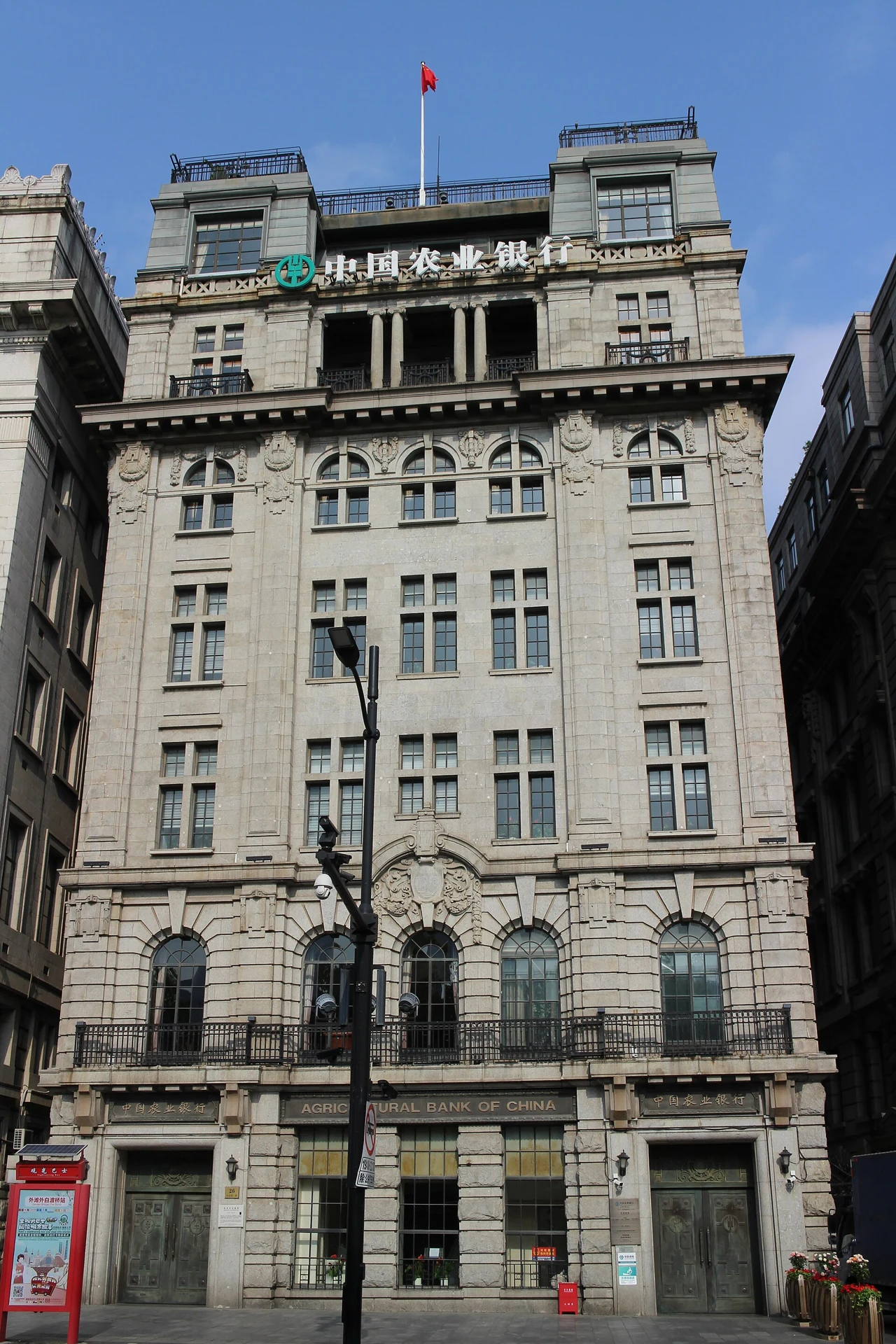
1 May 2025
Yangtze Insurance between two broader neighbours. Lower arches, vertical middle window rows and a high colonnade divide the narrow façade into distinct levels.
Suicasmo · Image source · CC0 1.0
At a glance
- Construction
- 1916–1918According to Shanghai Urban Construction Archives; another account gives 1917–1920
- Design
- Palmer & TurnerPalmer & Turner
- Style
- Eclectic, with a neoclassical foundationRead alongside the façade and original use.
- Original use
- Yangtze Insurance Association officesOriginal function of the surviving building.
- Current use
- Financial offices associated with the Agricultural Bank of ChinaAccording to the official historic-building register; occupants and arrangements are determined by the operator.
- Location
- 26 Zhongshan East 1st RoadNorthern Bund
The beginning
Why was it built here?
Between Yokohama Specie Bank and Jardine Matheson, the Yangtze building has a narrow river frontage but represents an essential part of the Bund economy: insurance. Ships and cargo travelling far afield needed risk protection as well as bank financing.[1] [3]
Yangtze Insurance grew from the business network of Russell & Co. and later operated independently. By purchasing and rebuilding 26 the Bund, it left the insurer’s name on this stretch of street.[1] [3]
Look up, then look closer
Three details worth a closer look
Start with the heavy two-storey base
Rougher stonework below and rhythmic second-floor arched windows make the smooth upper walls appear lighter. Even this small building gains a clear hierarchy.[3]
A colonnade high above the ground
The upper colonnade stands above several office floors rather than directly on the ground. Following the façade upwards reveals how classical elements were fitted into a commercial office building.[3]
Vertical order in a narrow frontage
Window rows and pilasters align neatly through the middle, with a pitched roof closing the outline. The building retains compact proportions between its two broader neighbours.[3]
One building, changing roles
History unfolds between the photographs
From earlier buildings to the one standing today. Captions distinguish photographic dates from publication dates; periods without reliable images are covered in the text.
- 19th century
From trading house to insurer
Yangtze Insurance had historical ties to Russell & Co., providing protection against shipping and trade risks.[1]
- After 1891
An independent company
After Russell & Co. withdrew, the insurer continued operating and developed business connections in ports beyond Shanghai.[1]
- 1916–1918
- 1920s
Part of a continuous streetscape
In a northern Bund photograph published in 1927, Yangtze stands between Yokohama Specie Bank and Jardine. It is small in the frame, which records the whole stretch of street.[3] [4]
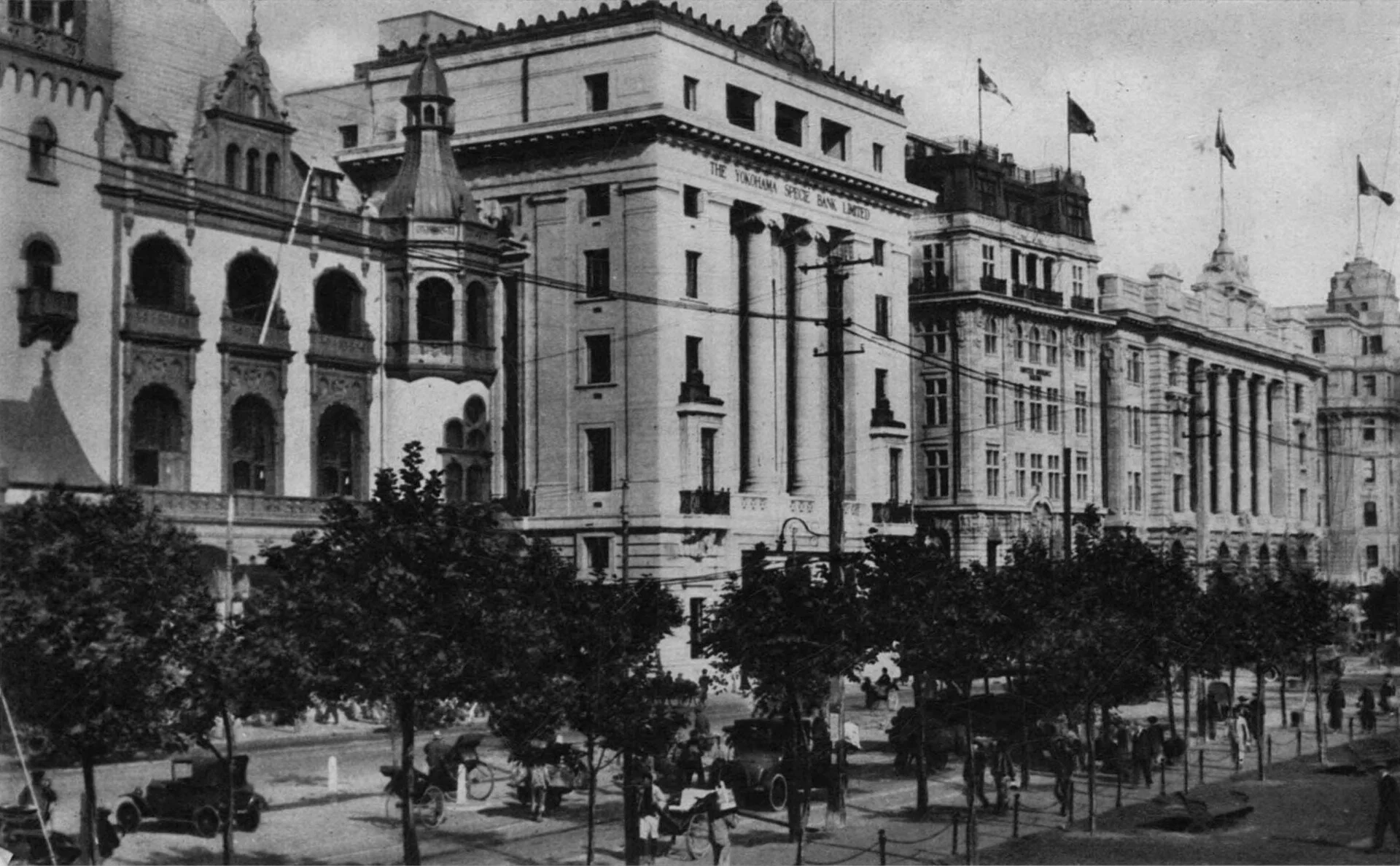
Published in 1927 · exposure date unknown
A northern Bund streetscape: Yangtze is the narrower building between Yokohama Specie Bank and Jardine. This is a historical street view containing the building, not a close-up of it alone.
Photographer unknown; published by A. S. Watson & Co. · Image source · Public domain
- 1941 and after the war
War and resumed business
After the outbreak of the Pacific War the building was occupied; after the war several insurance institutions rented space within it.[1]
- After 1967
Trade offices take over
After takeover, a grain and oil import-export company used the building. Its function shifted from the old insurance sector to new trade administration.[1]
- Recent years
Agricultural Bank of China use
Shanghai’s Outstanding Historic Buildings register records Agricultural Bank of China use of 26 the Bund. Confirm internal institutions and services using the bank’s current information.[2]
Today and visiting
Discover the building from the street
View the whole silhouette from the riverside promenade, then approach along the pavement to examine entrances and stonework.[2]
- Exterior
- View the front from the Huangpu River side; use nearby pedestrian crossings.
- Details
- Look for entrances, capitals and window rows; avoid lingering in doorways.
- Interior access
- The building remains in use. Follow the operator’s rules that day for visits, photography and business access.
Sources checked: 2026-10-19 · This architectural account does not imply public access to interiors. Historical opening hours are not evidence of current access.
Shanghai and the world
The port network behind an insurance policy
Yangtze Insurance established branches or agency connections in Hong Kong, London, New York, Singapore and elsewhere. Its office at 26 the Bund joined these cities in a network handling trade risks, showing that the financial street’s story extends far beyond deposits and exchange.[1]
Text and image sources
This article reorganizes the sources below. Text adapted and condensed from Wikipedia, including its translations here, is provided under CC BY-SA 4.0; the original contributors are listed in the article’s revision history. Image licences are listed separately beneath each photograph.
- Wikipedia · Yangtze Insurance Building ↗
Basic history and architectural information; the source article was rewritten and arranged in Chinese.
- Shanghai Housing Administration · Third batch of Outstanding Historic Buildings ↗
The register records Agricultural Bank of China use at 26 Zhongshan East 1st Road; it does not establish specific customer services or opening hours.
- Shanghai Urban Construction Archives · Buildings of the Bund ↗
Building profiles published by Shanghai Urban Construction Archives; dates that differ from other accounts are noted in the text.
- Historical photograph · File description and original source ↗
Checks the depicted subject, provenance and publication year; unknown exposure dates are explicitly marked.
Image handling and dating
Images come from the archives or image source pages listed beneath each photograph. We resize and compress them to WebP, preserving their original proportions without colourisation or added detail. Grain, blur and scanning marks in historical photographs are retained.
Photographs retain their original proportions and colours; they have only been resized and converted to WebP. Preview and full-resolution images show the same frame.
Dates for historical photographs distinguish exposure, publication and digitisation according to the source.
The archival image is a streetscape published in 1927. At the Bank of China site it shows the predecessor of the surviving tower; Yangtze and Jardine are identified by their positions in the frame.