No. 15, the Bund · Zhongshan East First Road
Russo-Chinese Bank Building
华俄道胜银行大楼
Classical order on a small scale, through successive chapters of international finance
Explore the past and present of No. 15, the Bund, through historic photographs, architectural details and a timeline.
Follow its history through photographs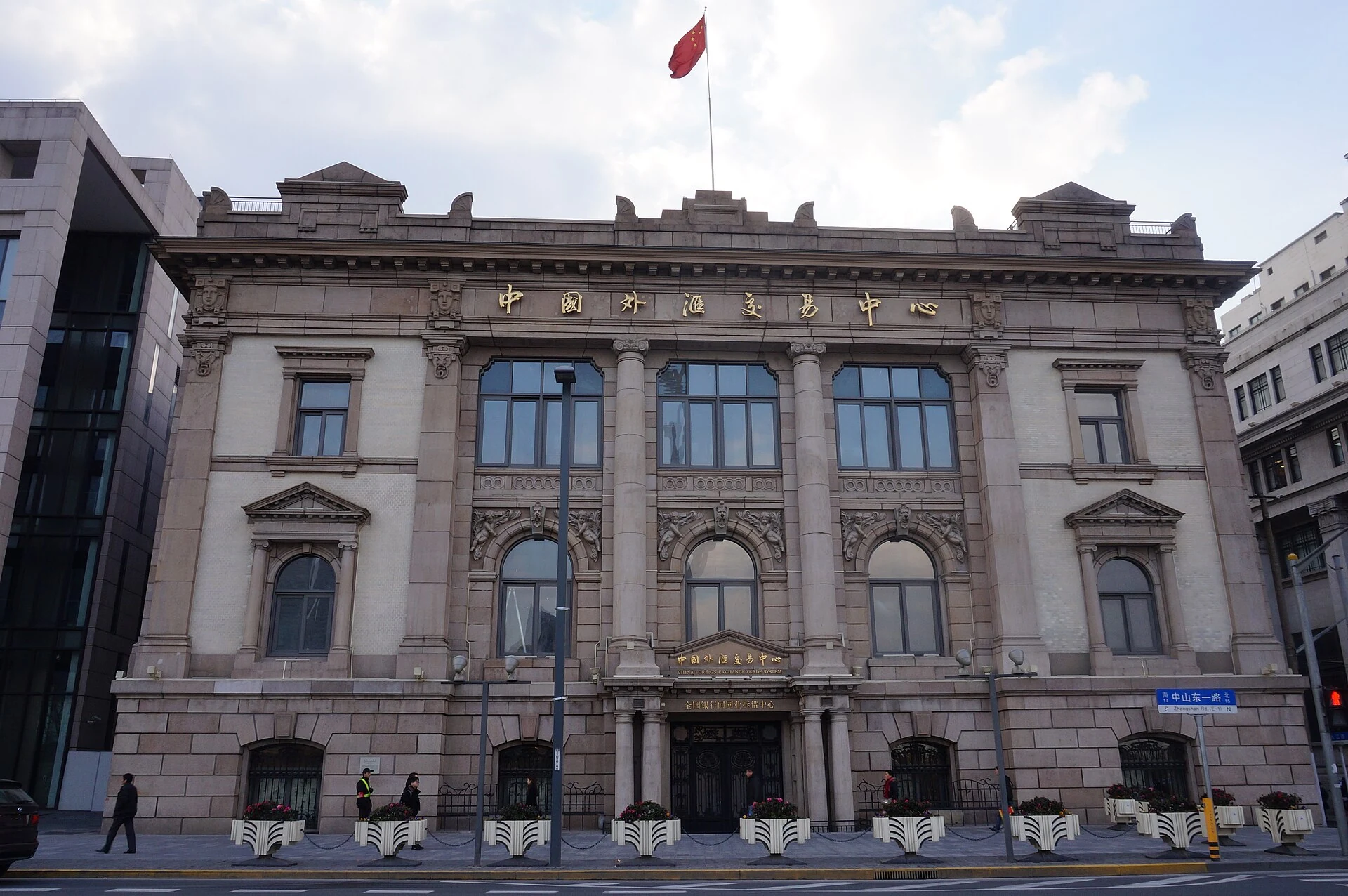
14 January 2014
The river façade of the Russo-Chinese Bank. Giant-order columns, carved window heads and a horizontal cornice compose a low but complete front.
Livelikerw · Image source · CC BY-SA 3.0
At a glance
- Construction / completion
- 1900–1902Dates from Shanghai Urban Construction Archives; some entries give 1903
- Architect
- Becker & BaedekerGerman architect Heinrich Becker
- Style
- French ClassicismThree-part composition and Ionic order
- Original use
- Russo-Chinese Bank, Shanghai branchLater the address of the Central Bank
- Current use
- Offices associated with the China Foreign Exchange Trade SystemChecked against an official institutional address list
- Location
- 15 Zhongshan East 1st RoadCorner on the south side of Jiujiang Road
The beginning
Why was it built here?
The Russo-Chinese Bank bought No. 15 in 1899 and then built a new branch. Shanghai Urban Construction Archives gives a construction period of 1900–1902, and Huangpu District Archives also records completion in 1902. This account follows the two archival institutions while retaining the discrepancy with entries giving 1903.[2] [3]
The bank connected the Qing government with Russian and French capital. Its permanent premises on the Bund gave this international financial network a physical address. After the bank closed, the Central Bank moved in, followed in time by foreign-exchange institutions: one building accommodated successive financial systems.[3]
Look up, then look closer
Three details worth a closer look
A complete central axis without great height
Lower than its neighbours, the building achieves balanced proportions through a central entrance, window rows on both wings and a projecting cornice. Its horizontally extended front remains easy to recognise among the taller Bund buildings.[3]
Scroll capitals and sculpted faces
Columns spanning the upper floors have Ionic scrolls, with human figures above windows and below the cornice. Examine the capitals and window heads slowly to appreciate the density of detail beyond the overall view.[3]
A corner joining two façades
Jiujiang Road offers another angle from the river-facing front. Walk around the corner to see how window rows, the stone base and roofline continue along the street. This is a building worth looking at again from its side.[2]
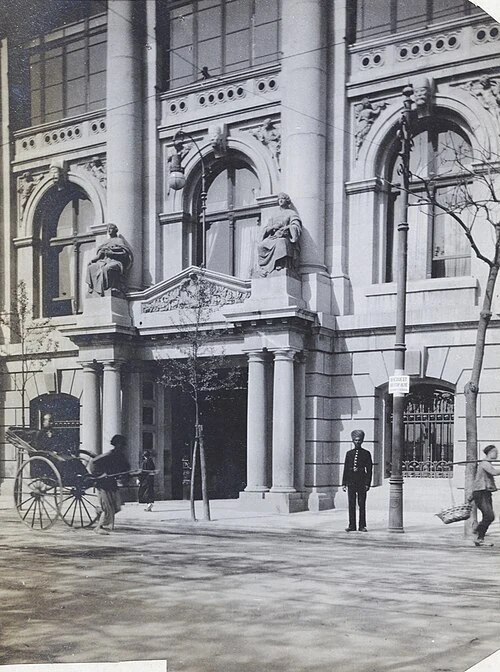
Around 1905–1908
George Alfred Johnson’s streetscape outside the bank, with a Sikh policeman at right. Entrance statues, arched windows and columns are clearly preserved; this is not a distant view of the entire building.
George Alfred Johnson (1879–1952) · Image source · Public domain
One building, changing roles
History unfolds between the photographs
From earlier buildings to the one standing today. Captions distinguish photographic dates from publication dates; periods without reliable images are covered in the text.
- 1899
Land acquired for a branch
The bank acquired property formerly belonging to Dent & Co. and invited designs for a new building. The acquisition preceded construction of the surviving building.[2]
- 1900–1902
Becker’s new building is completed
The present building took shape during these years. An entrance photograph from around 1905–1908 preserves sculptures and arched windows for comparison with today’s façade. It is not a distant view of the whole building.[3] [2] [5]
Around 1905–1908
George Alfred Johnson’s streetscape outside the bank, with a Sikh policeman at right. Entrance statues, arched windows and columns are clearly preserved; this is not a distant view of the entire building.
George Alfred Johnson (1879–1952) · Image source · Public domain
- 1926
The original bank closes and is liquidated
A financial crisis at the Russo-Chinese Bank closed its branches. The premises subsequently entered the history of another financial institution.[3]
- 1928
The Central Bank is established here
On 1 November, the Central Bank was established in Shanghai at No. 15, the Bund. “Central Bank Building” consequently became another name for these premises.[3]
- 1938–late 20th century
Major repairs and several office uses
Major work in 1938 expanded the space. Several institutions used the building after 1949. Façade ornament also suffered damage and subsequent restoration; historic photographs help explain what survives today.[3]
- Today
A foreign-exchange institution still lists this address
Official institutional information continues to list the China Foreign Exchange Trade System at 15 Zhongshan East 1st Road. Financial use continues, but this is not a gallery freely open to individual visitors.[4]
Today and visiting
Discover the building from the street
Pause at Jiujiang Road and read the front columns together with the side windows.[4]
- Details to find
- The riverfront offers a full façade view; the Jiujiang Road pavement is useful for the corner and window heads.
- Compare the buildings
- The vertical lines of No. 14 to the south contrast strongly with the classical capitals here.
- Interior limits
- These remain financial offices. Visitors should primarily view the exterior from public pavements.
Sources checked: 2026-10-19 · References to interior stained glass and stairs do not mean they are currently open to visitors.
Shanghai and the world
From St Petersburg and Paris to a Shanghai financial address
Russian and French capital participated in the Russo-Chinese Bank, alongside a Qing government shareholding. Its Shanghai address recalls how closely banking networks were tied to modern international politics. The later Central Bank and foreign-exchange institutions gave the same building different institutional roles.[3]
The classical façade is often compared with France’s Petit Trianon. This is a reference in composition and proportion; the building before you was designed for a Shanghai street corner and the work of a bank.[3]
Text and image sources
This article reorganizes the sources below. Text adapted and condensed from Wikipedia, including its translations here, is provided under CC BY-SA 4.0; the original contributors are listed in the article’s revision history. Image licences are listed separately beneath each photograph.
- Wikipedia · Russo-Chinese Bank Building, Shanghai ↗
Cross-check of the basic history. The Chinese base text is reorganised and rewritten; differing dates are explained in the text.
- Shanghai Urban Construction Archives · Russo-Chinese Bank and Bank of Taiwan ↗
The archives’ 2023 architectural account supplies construction dates and design information.
- Huangpu District Archives · Russo-Chinese Bank Building ↗
Completion in 1902, architectural details and institutional history. Occupants in older accounts are not automatically treated as current.
- Shanghai Financial Services Office · Financial institution address list ↗
Page 56 lists the China Foreign Exchange Trade System at No. 15. The Gold Exchange address in older writing is not carried forward as current.
- University of Bristol Historical Photographs of China / Commons · Outside the bank ↗
George Alfred Johnson, around 1905–1908, collection number GJ02-04; Commons marks PD-old-70 and PD-scan.
Image handling and dating
Images come from the archives or image source pages listed beneath each photograph. We resize and compress them to WebP, preserving their original proportions without colourisation or added detail. Grain, blur and scanning marks in historical photographs are retained.
The historic image is an entrance streetscape from around 1905–1908, with a named photographer and University of Bristol collection number; it is not a portrait of the whole building.
The route retains the searchable name Russo-Asiatic; the text uses the original owner’s name, Russo-Chinese.