No. 14, the Bund · Zhongshan East First Road
Bank of Communications Building
交通银行大楼
A late addition to the Bund, moving towards a simpler modern bank
Explore the past and present of No. 14, the Bund, through historic photographs, architectural details and a timeline.
Follow its history through photographs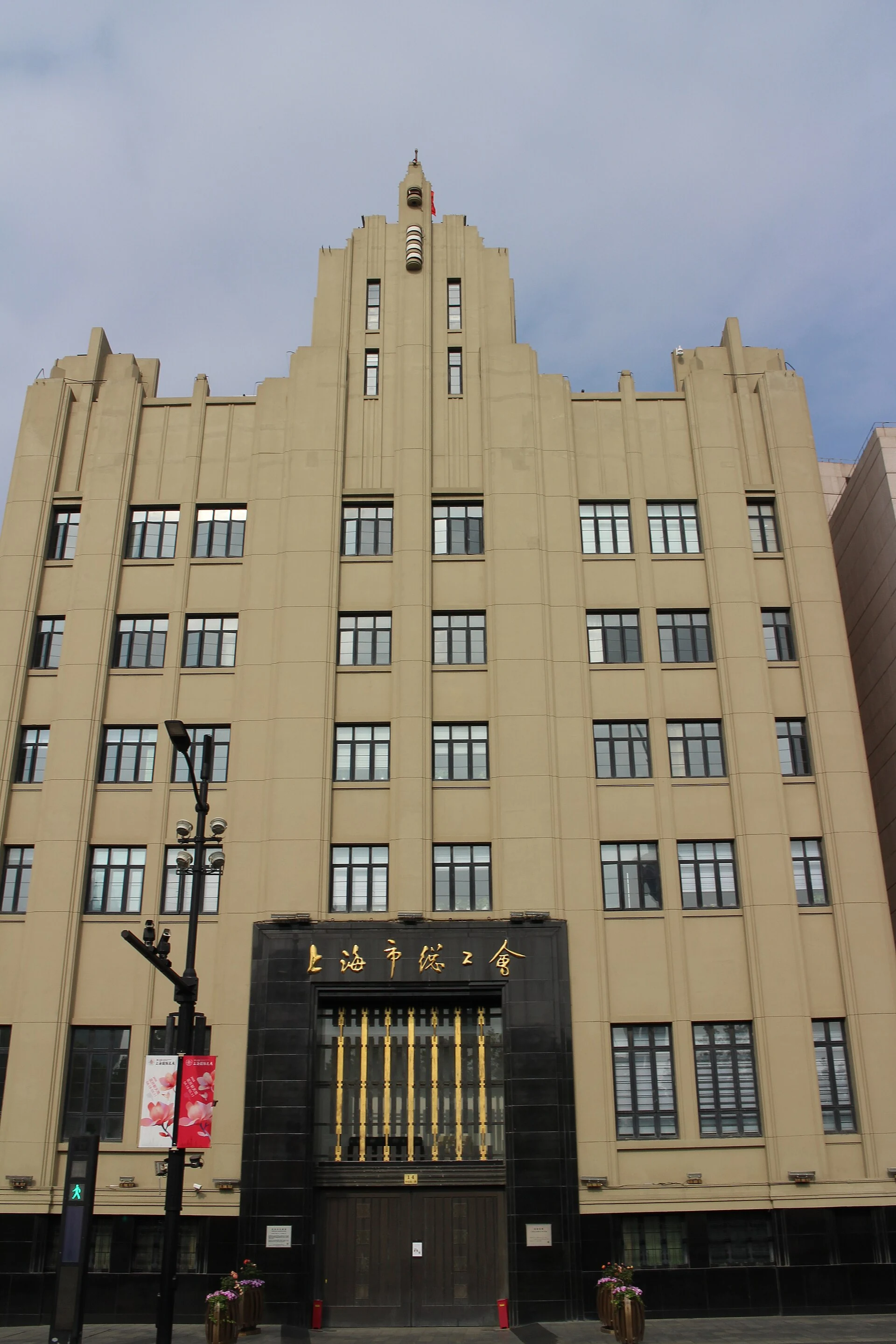
1 May 2025
The surviving Bank of Communications Building. Continuous verticals, a raised central crown and a dark entrance distinguish it from its classical neighbours.
Suicasmo · Image source · CC0
At a glance
- Construction / completion
- 1946 / 1948A design existed in 1937; completed in October 1948
- Architect
- C. H. GondaHuagai Architects helped revise the design after the war
- Style
- Art DecoVertical lines and a stepped central crown
- Original use
- Bank of Communications headquartersBanking hall and offices
- Current use
- Shanghai Federation of Trade Unions BuildingIncludes an exhibition space devoted to model workers
- Location
- 14 Zhongshan East 1st RoadBetween Customs House and the Russo-Chinese Bank
The beginning
Why was it built here?
No. 14 once belonged to Dent & Co. and was later used by the Deutsch-Asiatische Bank. When the Bank of Communications moved in in 1919, it occupied an older, ornamented building. Today’s pale façade with vertical lines resulted from post-war reconstruction.[2]
C. H. Gonda had designed the new building in 1937, but war interrupted the project. Huangpu District Archives records that Huagai Architects revised the plans after the war; construction began in 1946 and ended in 1948. The building process itself records a period when war interrupted city life before it resumed.[2]
Look up, then look closer
Three details worth a closer look
Vertical lines replace dense ornament
The piers between windows create continuous upward lines, with fewer sculptures than on neighbouring façades. Even without knowing the term Art Deco, its square outline and repeated rhythm are recognisable.[2]
A centre taller than its wings
The two sides are lower, while the centre rises and steps back. Look at the roof: changing volumes establish the centre, with a lighter appearance than the classical stone buildings on either side.[3]
A dark entrance in a pale façade
Dark stone around the lower entrance contrasts clearly with the light walls. Examine the door surround close up, then step back towards the river to see all the window rows and compare the scale of the banking entrance with the office block. [3]
One building, changing roles
History unfolds between the photographs
From earlier buildings to the one standing today. Captions distinguish photographic dates from publication dates; periods without reliable images are covered in the text.
- Late 19th–early 20th century
The earlier Deutsch-Asiatische Bank
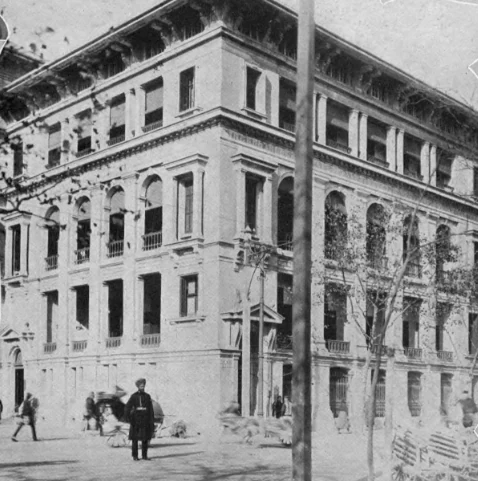
The image in a 1908 publication shows the predecessor on this site. Its tower and roof ornaments have disappeared. It must not be labelled an early photograph of the Bank of Communications building completed in 1948.[2]
Published in 1908 · photograph date unknown
The predecessor, the Deutsch-Asiatische Bank, in a 1908 publication. The present Bank of Communications Building, completed in 1948, did not yet exist.
Edited by Arnold Wright; photographer not separately credited · Image source · Public domain
- 1919
The Bank of Communications moves in
The Shanghai branch moved into No. 14, and the headquarters later moved to Shanghai too. The street number remained while the institution and interior uses gradually changed.[2]
- 1937
War interrupts the design
After C. H. Gonda completed the plans, the full-scale War of Resistance against Japan halted construction. This building was not completed alongside the Bund’s banks of the 1920s.[2]
- 1946–1948
Construction resumes and the new building opens
Built by Tao Fuji Construction, the building was completed in October 1948. Its surviving exterior dates from this phase, making it a relatively late member of the riverside historic group.[3]
- 1951
- 2025
The model workers exhibition is renewed
Official reporting records the reopening of the renovated model workers exhibition. Visiting the gallery and entering office areas are separate arrangements; follow current notices.[5]
Today and visiting
Discover the building from the street
Compare this building with Customs House to the south and the Russo-Chinese Bank to the north: three periods and three façades.[5]
- From the pavement
- Find the dark entrance, then the central setbacks above. Do not block staff entering or leaving.
- Exhibition visits
- The model workers exhibition was renewed in 2025. Confirm current reservations and accessible areas with the organiser.
- Compare two neighbours
- No. 15 to the north emphasises columns and relief figures, offering a direct comparison of two approaches to bank architecture.
Sources checked: 2026-10-19 · This office building is not freely accessible throughout. No unverified opening hours are given here.
Shanghai and the world
International design and local construction
Gonda was a Hungarian architect working in Shanghai, while a Chinese-owned contractor built the bank. A Bund building cannot be defined by one foreign name alone: design, revision and construction each retain the traces of different participants.[3] [2]
Text and image sources
This article reorganizes the sources below. Text adapted and condensed from Wikipedia, including its translations here, is provided under CC BY-SA 4.0; the original contributors are listed in the article’s revision history. Image licences are listed separately beneath each photograph.
- Wikipedia · Bank of Communications Building ↗
Cross-check of the basic history. The Chinese base text is reorganised and rewritten; differing dates are explained in the text.
- Huangpu District Archives · Bank of Communications Building ↗
The earlier site, the 1919 move, pre-war design, Huagai revisions and change of use in 1951.
- Shanghai Civil Affairs Bureau · Bund buildings and Pudong craftspeople ↗
Tao Fuji Construction, the 1946–1948 works and façade materials.
- Labour Daily · Continuity and purpose at No. 14, the Bund ↗
A 2024 report on the trade union federation’s history in the building.
- Shanghai Administration of Sports · Model Workers Exhibition ↗
A 2025 report on the renewed exhibition space; no promise of current opening hours.
Image handling and dating
Images come from the archives or image source pages listed beneath each photograph. We resize and compress them to WebP, preserving their original proportions without colourisation or added detail. Grain, blur and scanning marks in historical photographs are retained.
The historic photograph shows the earlier Deutsch-Asiatische Bank on this site; 1908 is the source’s publication year.
No early photograph of the separate 1948 building with a confirmed reuse licence has yet been included. This gap in the record is retained.