No. 16, the Bund · Zhongshan East First Road
Bank of Taiwan Building
台湾银行大楼
Four giant columns on a corner, and a changing history of banking
Explore the past and present of No. 16, the Bund, through historic photographs, architectural details and a timeline.
Follow its history through photographs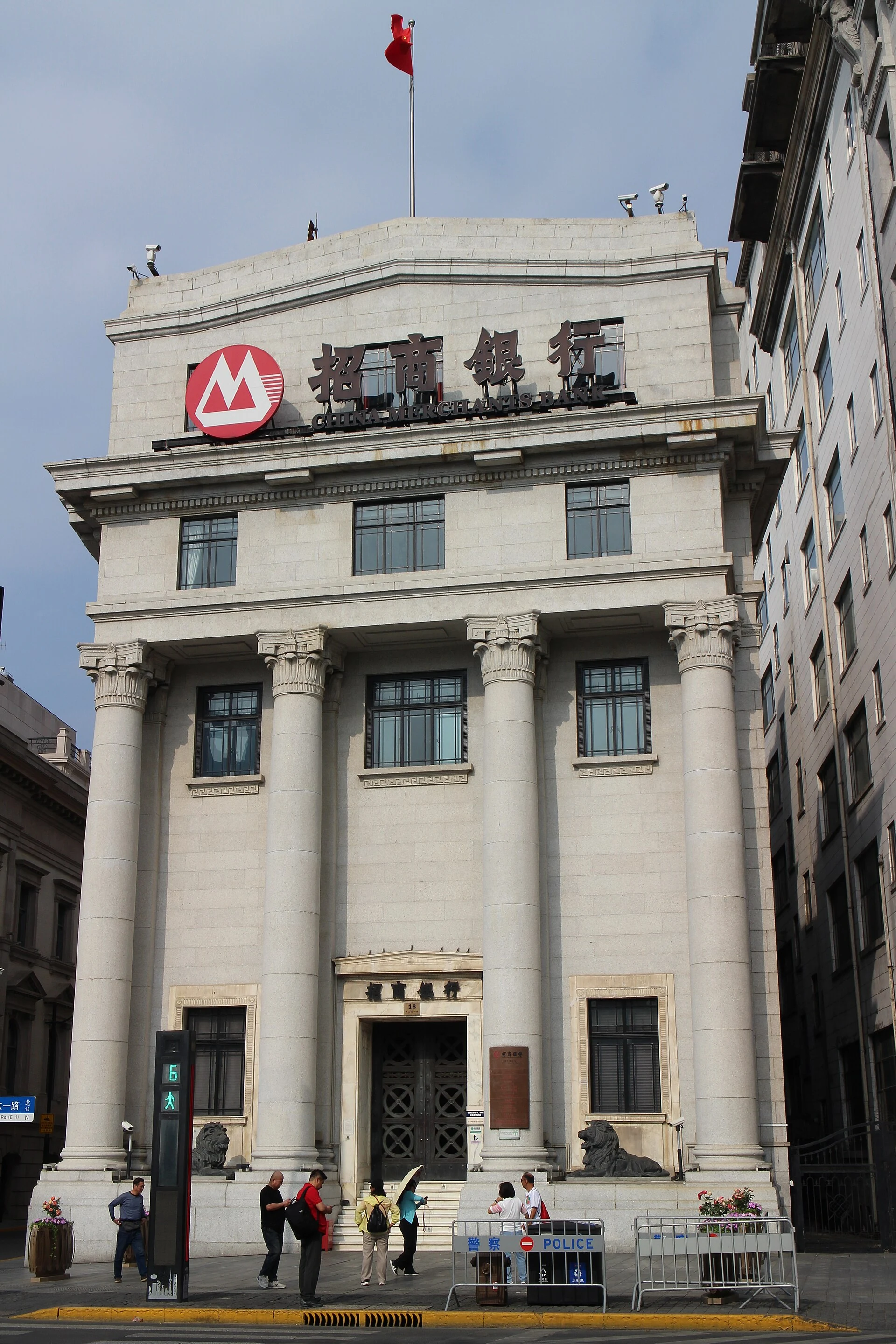
1 May 2025
The former Bank of Taiwan’s river façade, with today’s China Merchants Bank sign above the four robust columns.
Suicasmo · Image source · CC0
At a glance
- Construction / completion
- 1924 / 1927Construction period according to the urban construction archives
- Architect
- Lester, Johnson & MorrissLester, Johnson & Morriss
- Style
- Greek RevivalClassical orders simplified and reworked
- Original use
- Bank of Taiwan, Shanghai branchShanghai premises of the bank during Japanese rule in Taiwan
- Current use
- China Merchants Bank, Bund branchOfficial branch list gives 16 Zhongshan East 1st Road
- Location
- 16 Zhongshan East 1st RoadCorner on the north side of Jiujiang Road
The beginning
Why was it built here?
The building takes its name from the Bank of Taiwan of that period. It served the financial system under Japanese rule; its foundation cannot be understood simply from a modern bank name. Reconstruction began in 1924 and produced the surviving building in 1927.[1] [2]
Unlike some Bund towers, No. 16 is modest in volume. Lester, Johnson & Morriss concentrated on giant river-facing columns and the corner setting. Rather than competing in height, the façade uses oversized columns to give the bank a dignified entrance.[2]
Look up, then look closer
Three details worth a closer look
Four round columns spanning floors
Four thick columns on the east front are its clearest signature. They connect several tiers of windows, giving the small building a stronger sense of unity than its number of floors alone would suggest.[2]
Scrolls become geometric patterns
The capitals do not reproduce a textbook Ionic order. Their scrolls have become rectilinear meanders. Look closely to see the geometric character of these simplified classical forms.[2]
Around Jiujiang Road, columns become pilasters
Turning to the south side, the order is more closely integrated into the wall. Upper-storey heights and cornice lines are also more restrained. The river front and side have different emphases, rather than repeating one decoration on every face.[2]
One building, changing roles
History unfolds between the photographs
From earlier buildings to the one standing today. Captions distinguish photographic dates from publication dates; periods without reliable images are covered in the text.
- 1924
Reconstruction begins
The Bank of Taiwan began a new building at No. 16, designed by Lester, Johnson & Morriss and built by Xiang Mao Ji Construction.[1]
- 1927
Today’s colonnaded façade takes shape
The urban construction archives dates construction to 1924–1927. Calling 1924 simply the completion year would omit this period of work.[2]
- Before 1945
A photograph preserves the old bank
The old image clearly shows the four-column front and the Jiujiang Road side, with pedestrians carrying goods. The source says only before 1945; a more precise photographic year cannot be assigned.[4]
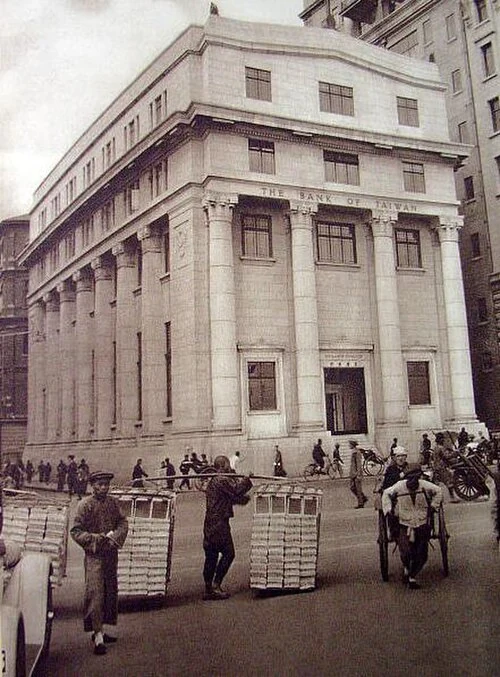
Before 1945 · exact photograph year unknown
The Bank of Taiwan in an old photograph: the four-column front and Jiujiang Road side appear together, with people carrying goods outside.
Photographer unknown · Image source · Public domain · PD-Japan-oldphoto
- Mid-20th century
Names and uses change
Later names included Farmers Bank of China Building and Gongyi Building. Different names at the same address must be matched to their particular periods of use.[1]
- 1994
Listed as an outstanding historic building
The building entered Shanghai’s second list of Outstanding Historic Buildings, protecting a form already distinctive in the streetscape.[1]
- Today
Still serving as a bank branch
China Merchants Bank’s official list places its Bund branch at 16 Zhongshan East 1st Road. The historic bank continues to accommodate contemporary financial services.[3]
Today and visiting
Discover the building from the street
View both façades from Jiujiang Road to understand the difference between freestanding columns and pilasters.[3]
- From a distance
- From the riverfront, compare the four giant columns and the height of the neighbouring buildings.
- Close up
- Look for geometric meanders on the capitals, the cornice and side pilasters.
- Interior access
- This is an operating branch. Banking services, security checks and accessible areas follow the bank’s arrangements for the day.
Sources checked: 2026-10-19 · Banking hours are not architectural visiting hours. This branch is not listed here as a freely accessible attraction.
Shanghai and the world
Greek composition reinterpreted in an East Asian port
The building reworks the Greek classical order into an architectural language for a 20th-century East Asian bank. Facing the French Classicism of No. 15 across the street, it offers a short walk comparing how different institutions borrowed European forms.[2]
Text and image sources
This article reorganizes the sources below. Text adapted and condensed from Wikipedia, including its translations here, is provided under CC BY-SA 4.0; the original contributors are listed in the article’s revision history. Image licences are listed separately beneath each photograph.
- Wikipedia · Bank of Taiwan Building, Shanghai ↗
Cross-check of the basic history. The Chinese base text is reorganised and rewritten; differing dates are explained in the text.
- Shanghai Urban Construction Archives · Russo-Chinese Bank and Bank of Taiwan ↗
The archives’ 2023 architectural account supplies construction dates and design information.
- China Merchants Bank · Branches offering witnessed Hong Kong account opening ↗
The official list gives the Bund branch at No. 16. Only the address is used here, not business reservation rules.
- Commons · Historic Bank of Taiwan branch photograph ↗
Sourced from TaiPics, marked before 1945 and licensed PD-Japan-oldphoto. The original monochrome is retained.
Image handling and dating
Images come from the archives or image source pages listed beneath each photograph. We resize and compress them to WebP, preserving their original proportions without colourisation or added detail. Grain, blur and scanning marks in historical photographs are retained.
The archive photographer and exact year are unknown; the source says before 1945. The licence follows the Commons file’s PD-Japan-oldphoto designation.
The modern photograph dates to 2025. Original proportions are retained when comparing it with the historic view.