No. 19, the Bund · Zhongshan East First Road
Palace Hotel
汇中饭店大楼
The red-and-white hotel at Nanjing Road now welcomes artists
Explore the past and present of No. 19, the Bund, through historic photographs, architectural details and a timeline.
Follow its history through photographs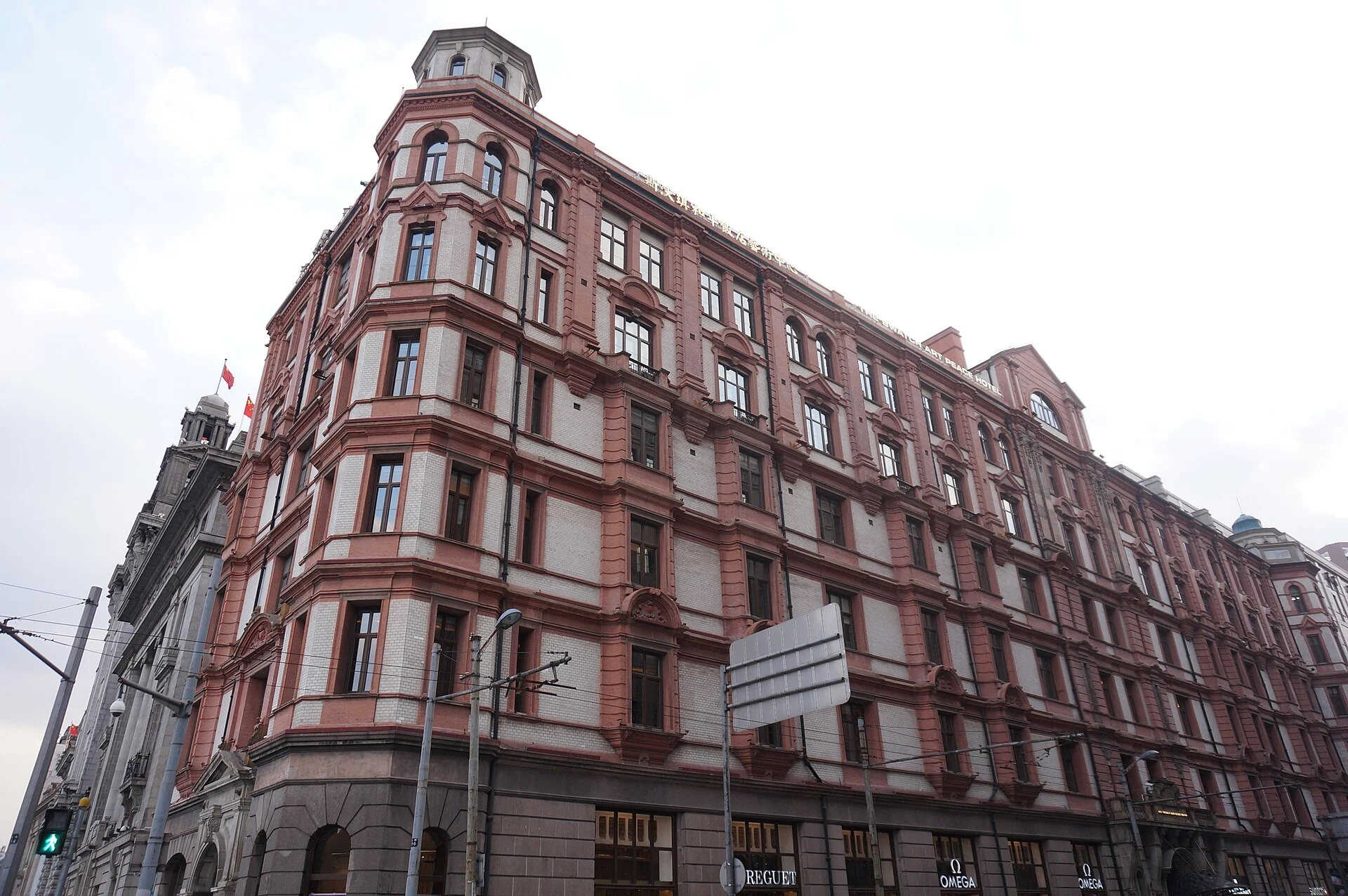
14 January 2014
The longer Palace Hotel elevation along Nanjing East Road. Red-and-white bands run along the windows towards the Bund corner at the far end.
Livelikerw · Image source · CC BY-SA 3.0
At a glance
- Construction / opening
- 1906 / 1908The Central Hotel preceded the present building
- Architect
- Morrison & Co.Walter Scott; built by Wang Fa Ji Construction
- Style
- Renaissance RevivalBands of brick and stone and a corner composition
- Original use
- Palace HotelHistorically called Huizhong Hotel in Chinese
- Current use
- Swatch Art Peace HotelArtist residencies, studios and ground-floor shops
- Location
- 19, the Bund / 23 Nanjing East RoadSouth of Nanjing East Road, distinct from No. 20 to the north
The beginning
Why was it built here?
The hotel history at No. 19 began with the 19th-century Central Hotel; today’s building was rebuilt in 1906–1908. Early photographs require care: the low old hotel is the predecessor, while the six-storey building with red-and-white bands is the surviving Palace Hotel.[1]
Later known as the Peace Hotel’s south building, it is separate from Sassoon House with its green pointed roof north of Nanjing Road. The Swatch Art Peace Hotel formally opened in 2011, turning hotel accommodation into places where artists live, create and exchange ideas.[3] [2]
Look up, then look closer
Three details worth a closer look
A red-and-white presence on the street
Repeated bands of brick and pale wall distinguish the south building from the Bund’s familiar grey stone façades. Walk along Nanjing East Road to see this colour relationship extend across the longer elevation.[1]
A building turning the corner
The river façade and the Nanjing Road elevation meet at the corner. Do more than take one riverfront photograph: walk around it and the window rows and roof silhouette reveal different proportions.[1]
Windows, stringcourses and roof divide the volume
Lower entrances, continuous window rows and horizontal stringcourses divide six storeys into readable sections. Roof elements finish this lower stretch of streetscape, contrasting with the tall pointed roof of the north building opposite.[1]
One building, changing roles
History unfolds between the photographs
From earlier buildings to the one standing today. Captions distinguish photographic dates from publication dates; periods without reliable images are covered in the text.
- 1860s
An image of the earlier Central Hotel
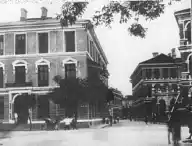
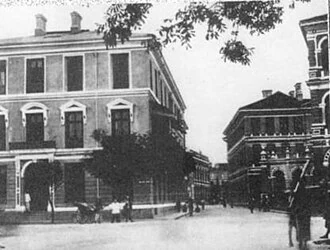
The archive image shows the early low-rise hotel. It is not the new building opened in 1908. Its date follows the source description, not the 2014 upload record.[4]
1860s · according to the source description
The early low-rise Central Hotel on this site, before rebuilding as today’s six-storey Palace Hotel.
Photographer unknown · Image source · Public domain
- 1906–1908
- 1909
The International Opium Commission meets here
The International Opium Commission met at the Palace Hotel, placing it in the history of international public affairs. It provided not only accommodation but also space for meetings and social life.[1]
- 1927
Hotel, bank and newspaper share a view
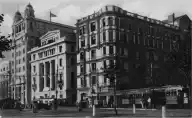
A published streetscape places the Palace Hotel at Nanjing Road beside the Chartered Bank and North-China Daily News to its south. The hotel is on the right, with the junction, entrance and building identifiable.[5]
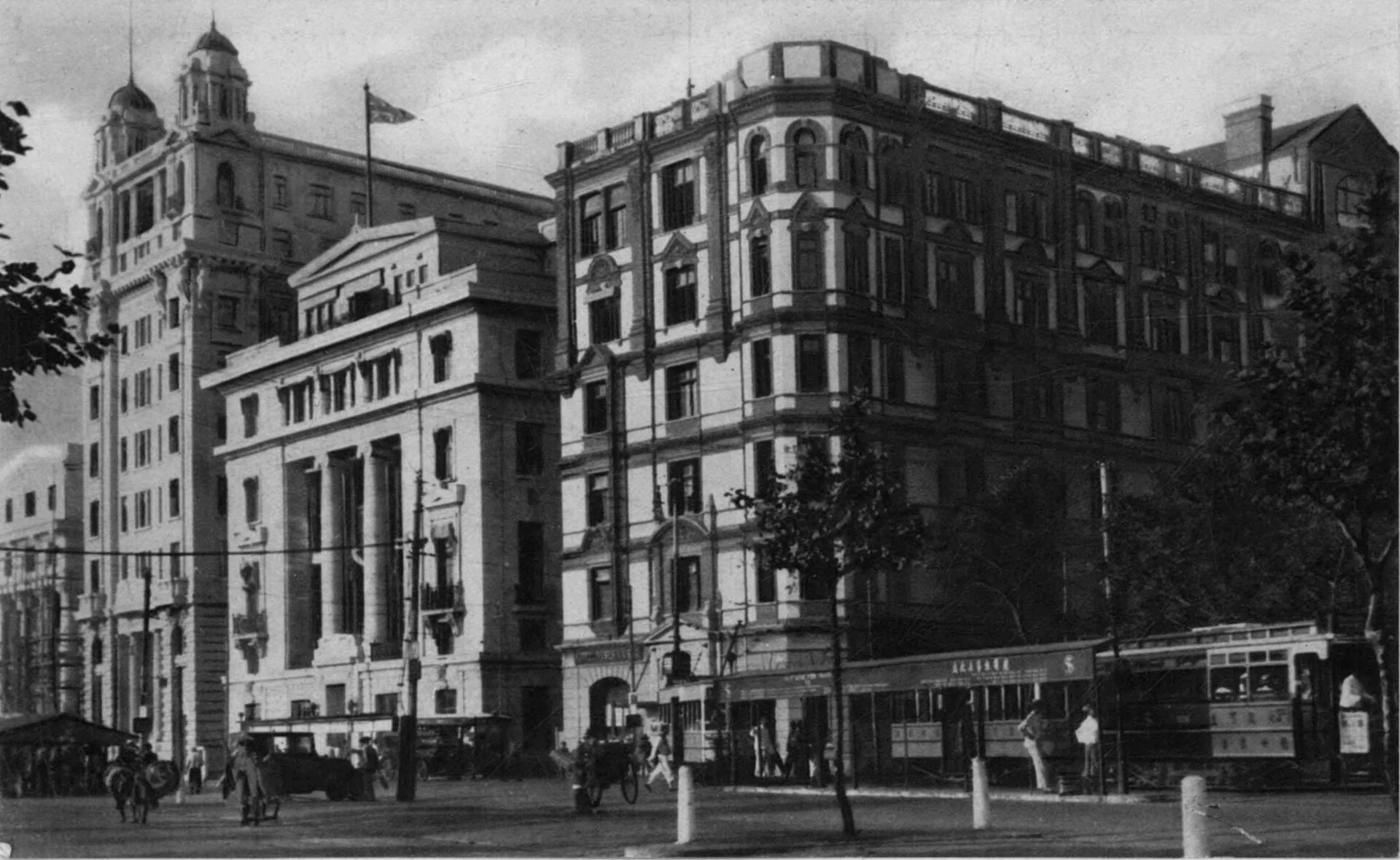
Published in 1927 · photograph date unknown
Plate 8 of Shanghai of Today. The tall hotel on the right-hand corner is the Palace Hotel; Chartered Bank and the newspaper building stand to its left.
Photographer unknown; published by A. S. Watson & Co. · Image source · Public domain
- Mid-20th century
It becomes the Peace Hotel’s south building
The old hotel later became part of the Peace Hotel establishment, leaving the long-used name “south building”. It should not be confused with the north building completed in 1929.[1]
- 2011
The art hotel formally opens
Swatch Group announced the official opening on 1 November 2011. Resident artists live and work inside, changing once again whom the building receives.[3]
- Today
Artistic work meets the city
The operator continues to describe artist residencies and ground-floor brand shops. Its value lies both in historic guest rooms and in the creative work still happening today.[2]
Today and visiting
Discover the building from the street
Locate No. 19 on the south side of Nanjing East Road. The green pointed roof to the north belongs to a different building.[2]
- See the whole building
- Walk from the Bund towards Nanjing East Road and compare the short river front with the long street elevation.
- Art events
- Check the art hotel’s current official information for publicly accessible exhibitions and events.
- Residency spaces
- Studios and residential floors are artists’ working and living spaces, not automatically open to tourists.
Sources checked: 2026-10-19 · The official address is 23 Nanjing East Road (19, the Bund). Arriving at the north building at No. 20 does not mean you have reached the south building.
Shanghai and the world
From international travellers to international artists
In the early 20th century, the hotel welcomed travellers arriving across the sea and hosted international meetings. Today’s residency invites artists from different countries and disciplines. Both eras bring people here to stay, but encounters have shifted from hotel life to shared creative work.[1] [2]
Swatch Group’s opening record in 2011 mentions artists from New York, Switzerland and Japan painting live on the Bund. The building’s global connections can be found both in old stories and in specific contemporary events.[3]
Text and image sources
This article reorganizes the sources below. Text adapted and condensed from Wikipedia, including its translations here, is provided under CC BY-SA 4.0; the original contributors are listed in the article’s revision history. Image licences are listed separately beneath each photograph.
- Wikipedia · Palace Hotel Building ↗
Cross-check of the basic history. The Chinese base text is reorganised and rewritten; differing dates are explained in the text.
- Swatch Art Peace Hotel · The Building ↗
The operator confirms the 1908 building, current use and address at 23 Nanjing East Road.
- Swatch Group · Official opening announcement, 2011 ↗
The text is dated 1 November 2011. The 2018 in the URL is not the opening year.
- Commons · Central Hotel photograph from the 1860s ↗
The source describes the predecessor in the 1860s; the upload date is not used.
- Commons · Shanghai of Today, Plate 8 ↗
The full streetscape includes the surviving Palace Hotel; published in 1927.
Image handling and dating
Images come from the archives or image source pages listed beneath each photograph. We resize and compress them to WebP, preserving their original proportions without colourisation or added detail. Grain, blur and scanning marks in historical photographs are retained.
This page concerns the Palace Hotel south building at No. 19, not Sassoon House, the north building at No. 20.
The 1860s image shows the predecessor; the 1927 streetscape includes today’s six-storey building.