No. 5, the Bund · Zhongshan East First Road
Nisshin Building
日清大楼
Shipping offices in a six-storey building at Guangdong Road
From Nisshin Steamship to maritime institutions and commercial dining, No. 5 Bund’s history lies in its regular windows, upper cornice and changing occupants.
Follow its history through photographs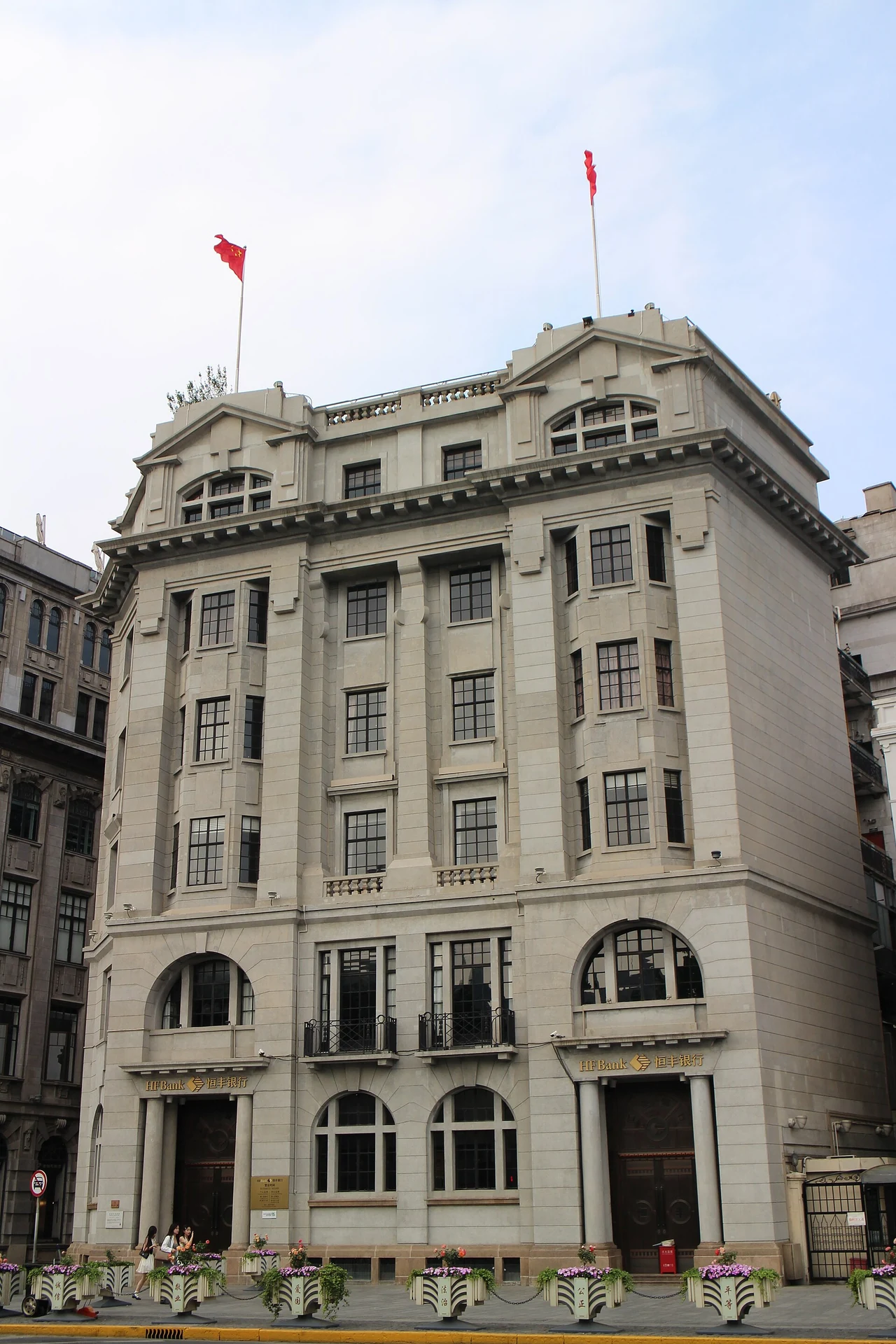
1 May 2025
The river front of the Nisshin Building. Straight window rows and the upper cornice set a different rhythm between the more varied neighbouring roofs.
Suicasmo · Image source · CC0 1.0
At a glance
- Construction / completion
- 1921 / 1925Recorded by Huangpu District Archives
- Architect
- Lester, Johnson & MorrisLester, Johnson & Morris
- Style
- Modern Japanese Western-style architectureClassical composition with restrained window rows
- Original use
- Nisshin Steamship and rental spaceDifferent investors used the lower and upper floors
- Current use
- No. 5 on the Bund commercial premisesDining and other uses; consult operators for current tenants
- Location
- 5 Zhongshan East 1st RoadEntrance side at 20 Guangdong Road
Architecture and use: sources[1]
The beginning
Why was it built here?
Nisshin Steamship was a shipping company. It acquired the No. 5 Bund property in the early 20th century and later rebuilt it with other investors. Its story begins with Yangtze and maritime transport; today’s restaurant names cannot explain its original function.[2]
Huangpu District Archives records that the Japanese side used the basement and lower three floors, while another investor held the upper three floors. This vertical division reminds us that a single Bund building could accommodate several institutions and interests at once.[2]
Look up, then look closer
Three details worth a closer look
Horizontal layers stand out more than elaborate ornament
Read upward from the ground-floor openings through the window rows to the upper cornice. Compared with the spires of the neighbouring Commercial Bank of China, its outline is straighter and its order steadier.[2]
Read the multi-storey pilasters from Guangdong Road
Some pilasters span several floors, linking windows into larger compositional units. The corner gives a view of both the river front and the depth of the side elevation.[2]
Missing ornament is part of the history too
Archive records say that later alterations removed stone sculpture. Today’s restraint reflects both design and subsequent changes; the present appearance does not prove that the original lacked decoration.[2]
One building, changing roles
History unfolds between the photographs
From earlier buildings to the one standing today. Captions distinguish photographic dates from publication dates; periods without reliable images are covered in the text.
- 1907
Nisshin Steamship is established
Several Japanese shipping operations on the Yangtze merged into Nisshin Steamship Company, which conducted business in Shanghai.[2]
- 1921–1925
Old premises give way to a new building
Low-rise buildings were demolished and replaced by a six-storey design by Lester, Johnson & Morris. It accommodated both the shipping company and other users.[2]
- 1945
China Merchants takes over
Japanese-owned assets were taken over after the war, and the building was for a time called the China Merchants office building. It is a different address from the historic China Merchants building at No. 9 Bund.[2]
- From the 1950s
Maritime institutions occupy it for decades
Maritime administration and other bodies moved in, giving rise to the name “Maritime Building”. Later work also changed some exterior details.[2]
- 1990s
Entrances and floors continue to change
The archives record an additional floor on the western part for a radio station. Huaxia Bank moved into the ground floor in 1996, adding an entrance on the south.[2]
- 2007
A photograph after alterations
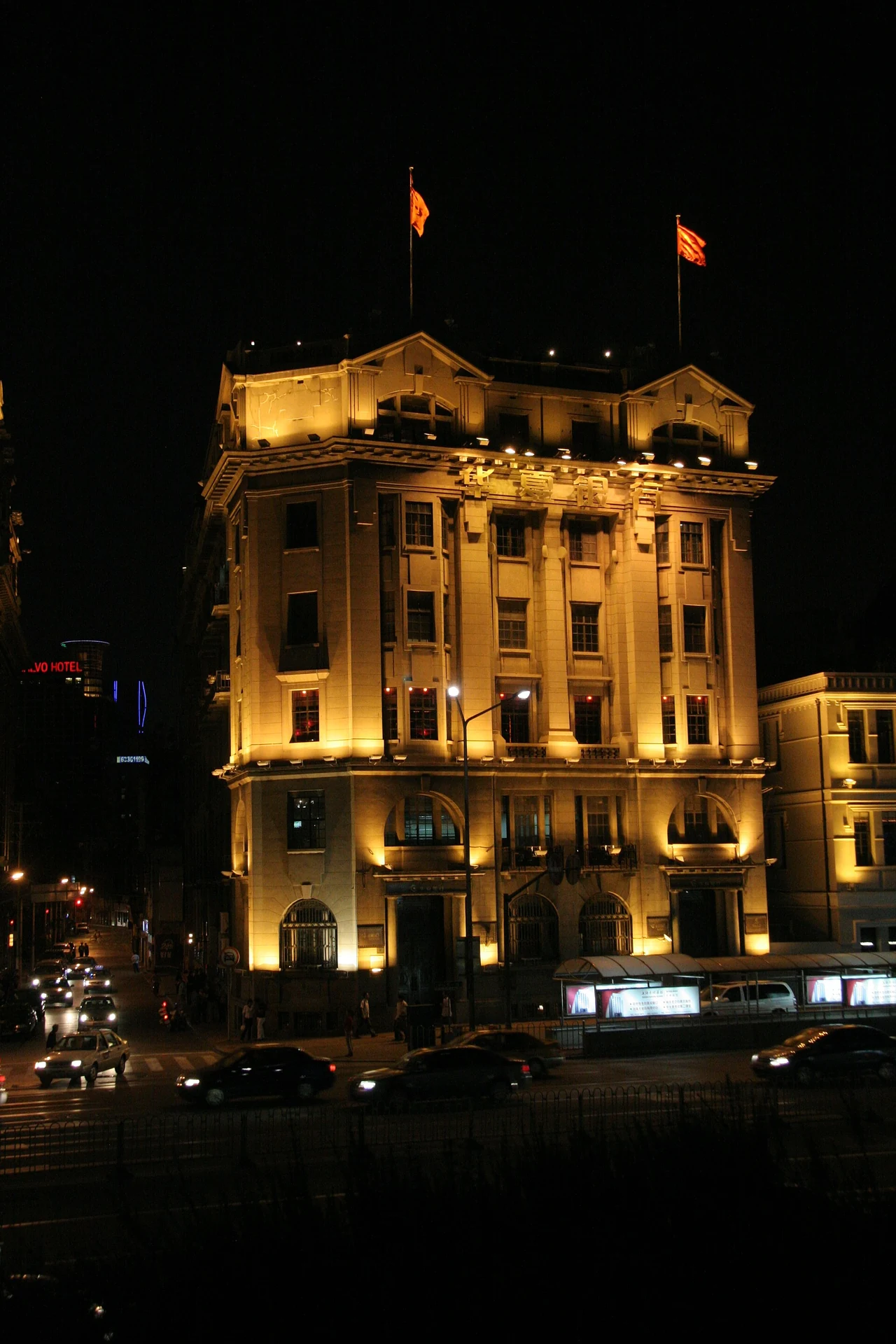
The 2007 photograph records the façade and street signs of this phase. Taken more than eighty years after completion, it documents later changes in use.
10 June 2007
The Nisshin Building at night in 2007, with Huaxia Bank lettering still visible. This records a former tenant, not evidence of present occupancy.
KimonBerlin · Image source · CC BY-SA 2.0
- Today
Shipping offices become commercial space
No. 5 on the Bund now accommodates dining and other uses. Recent restaurant listings still give 20 Guangdong Road; banks or M on the Bund in older accounts should not be assumed current tenants.[3]
Today and visiting
Discover the building from the street
The Guangdong Road corner makes it easy to identify this building and compare it with the Union Building across the street.[3] [2]
- Look at the cornice
- Look between the fifth and sixth floors for the shadow cast by the horizontal projection.
- Check the entrance
- “No. 5 on the Bund” names the building; access is often from the 20 Guangdong Road side.
- Visiting
- Read the exterior from the street; for restaurants, check the floor and arrangements for the day.
Sources checked: 2026-10-19 · Tenants and public access on every floor have not been confirmed. This page does not reuse booking details for closed businesses.
Shanghai and the world
Two China Merchants addresses, two buildings
China Merchants used the Nisshin Building after the war; further north, No. 9 Bund is the company’s office building completed in 1901. The same institution at different addresses is a recurring challenge when reading Bund history.[2]
Text and image sources
This article reorganizes the sources below. Text adapted and condensed from Wikipedia, including its translations here, is provided under CC BY-SA 4.0; the original contributors are listed in the article’s revision history. Image licences are listed separately beneath each photograph.
- Wikipedia · Nisshin Building, Shanghai ↗
Used to cross-check the building’s history; conflicting dates are identified in the text. The article was independently written for this site; photographic credits and licences are listed separately.
- Huangpu District Archives · Archive Gallery: Nisshin Building ↗
Archive feature of 2015; used to check construction in 1921–1925, Lester, Johnson & Morris, floor allocation and successive uses.
- NOMFLUENCE · Ruth’s Chris Steakhouse ↗
A recent restaurant listing gives the fourth floor of No. 5 on the Bund, 20 Guangdong Road. Used only to confirm dining use, not to guarantee opening hours.
Image handling and dating
Images come from the archives or image source pages listed beneath each photograph. We resize and compress them to WebP, preserving their original proportions without colourisation or added detail. Grain, blur and scanning marks in historical photographs are retained.
This page compares actual photographs from 2007 and 2025. No clearly licensed prewar photograph identifying this individual building has yet been included.
Historic views of other parts of the Bund have not been substituted for this building. Older photographs in the archives article can be viewed through its source link.