No. 3, the Bund · Zhongshan East First Road
Union Building
有利大楼
From insurance offices to Three on the Bund
A narrow river frontage and a long façade along Guangdong Road trace a century of insurance, banking and contemporary dining within one building.
Follow its history through photographs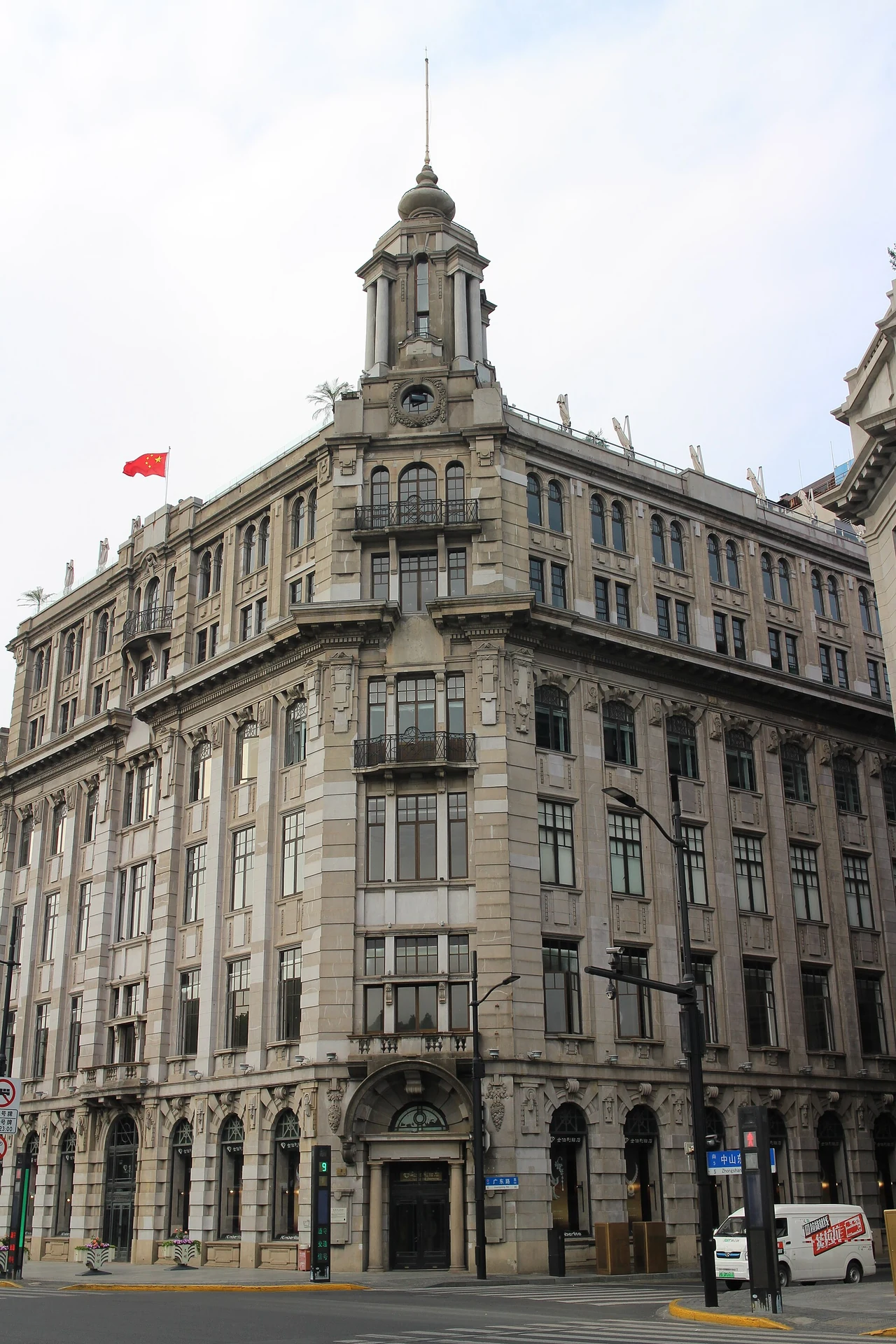
1 May 2025
The Union Building at the Guangdong Road junction. Its tower connects the river frontage with the long façade along Guangdong Road.
Suicasmo · Image source · CC0 1.0
At a glance
- Completed
- 1916Based on an architectural history report; other sources give 1918
- Architect
- Palmer & Turner · George WilsonPalmer & Turner / G. L. Wilson
- Style
- Free RenaissanceStone facing combined with a steel frame
- Original use
- Insurance offices and rental spaceOriginally called the Union Building
- Current use
- Three on the BundRestaurants and related commercial spaces
- Location
- 3 Zhongshan East 1st RoadFormerly No. 4 · Guangdong Road junction
Architecture and use: sources[1]
The beginning
Why was it built here?
“Union” came from the English name of the Union Insurance company, rendered in Chinese as Youning or Lianhe. After the Youli Bank moved in, the building became known by the bank’s Chinese name, Youli. Today “Three on the Bund” turns its street number into a commercial name.[1]
George Wilson led the project as Palmer & Turner established its Shanghai practice. Behind the classical exterior, a steel frame allowed offices to be divided more flexibly and left scope for later changes of use.[2] [1]
Look up, then look closer
Three details worth a closer look
The long façade is on Guangdong Road
The river side is only part of the building. Turn into Guangdong Road to see the rows of windows extending along the narrow plot, and how the longer frontage was placed on a cross street.[1]
The northeast tower joins two directions
The rooftop pavilion makes the corner distinctive. The entrance, circular window and roof silhouette rise one above another, visible from both the waterfront and Guangdong Road.[1]
The doorway rewards a closer look
Columns, curved ornament and carving surround the opening. The festive decorations in the detail photograph were temporary arrangements in 2013, not original architectural features.[1]
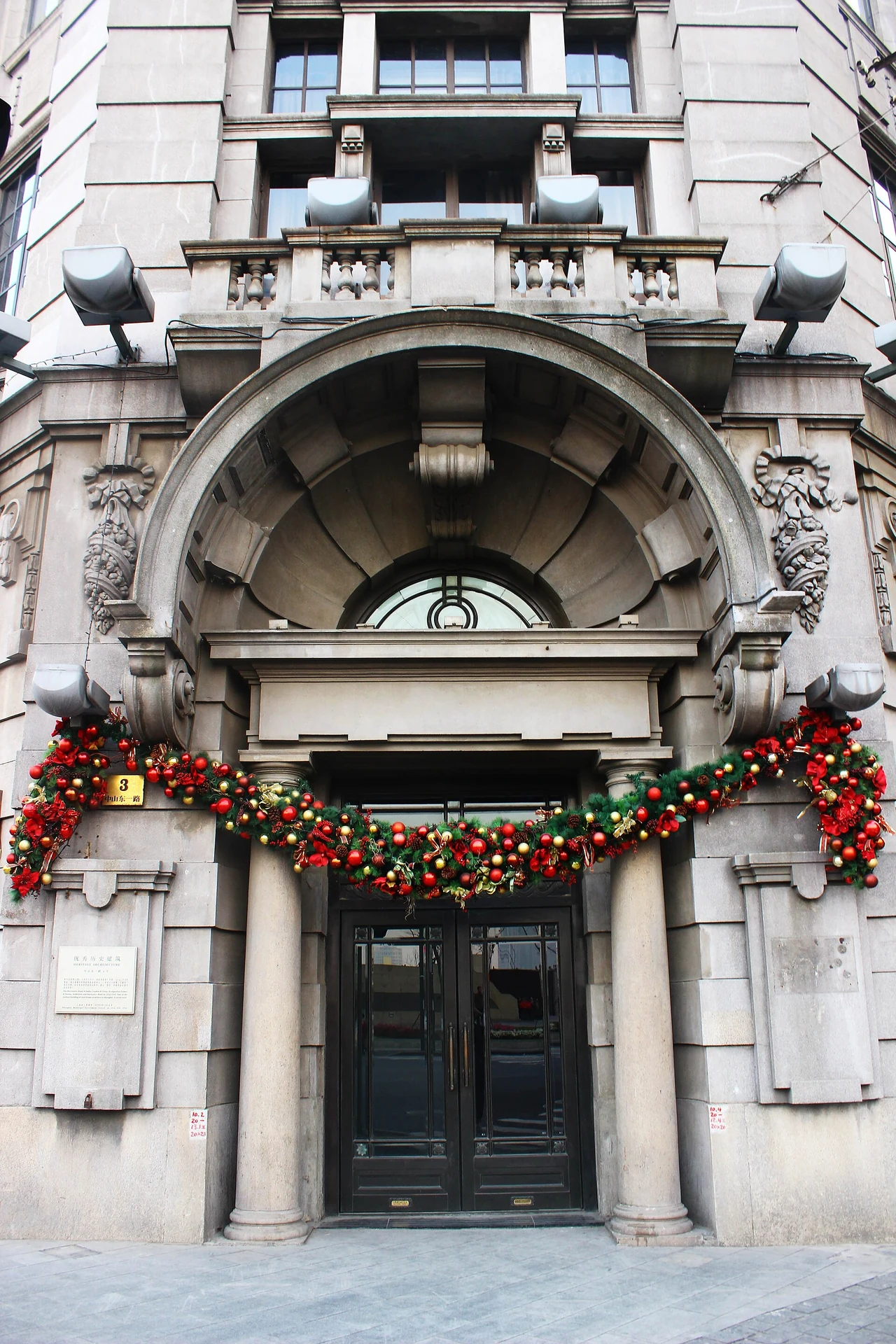
29 December 2013
Curved ornament and carving at the northeast entrance. The festive decorations on the door were temporary when photographed.
Legolas1024 · Image source · CC BY-SA 3.0
One building, changing roles
History unfolds between the photographs
From earlier buildings to the one standing today. Captions distinguish photographic dates from publication dates; periods without reliable images are covered in the text.
- 1912
- 1916
- 1922
The Youli Bank moves in
The bank became an occupier and its name became associated with the building. “Youli” was not the name of the original investor.[1]
- Second half of the 20th century
Institutional offices continue
Design and geological organisations successively worked here. Changing uses did not remove the corner pavilion from the Bund.[1]
- 1994
A colour record before conversion
The 1994 photograph preserves the building and road before it became Three on the Bund. It is an actual colour photograph, not an archive image from the 1920s.
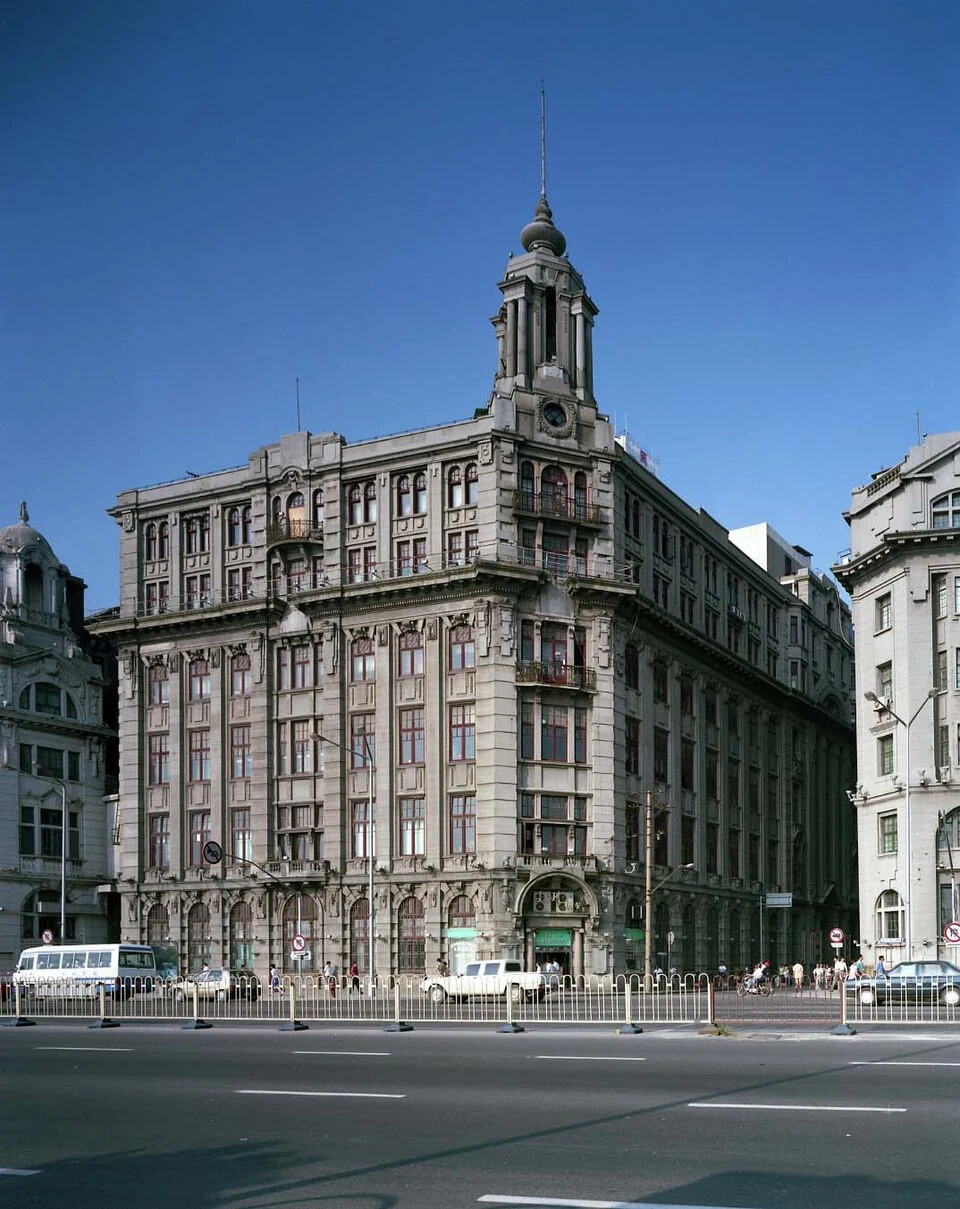
18 July 1994
A colour photograph before the commercial conversion. Compare window rows, pavilion and roads; this is not a prewar image.
Onedesign23 · Image source · CC BY-SA 4.0
- 2001–2004
Restoration and commercial conversion
Three on the Bund opened in 2004 after conversion, introducing restaurants and other uses. The architectural history report also records debate about the extent of the work.[2]
- Today
A street number becomes a lifestyle destination
The operator’s website still lists restaurants, terraces and tower spaces inside. Access follows the arrangements of the businesses concerned.[3]
Today and visiting
Discover the building from the street
After viewing the river frontage, walk a little way along Guangdong Road for a quite different sense of proportion.[3] [1]
- Find the number
- Today’s No. 3 Zhongshan East 1st Road and No. 4 in older records refer to the same building.
- Look at the entrance
- Examine the corner carvings and long Guangdong Road façade close up while keeping entrances clear.
- Going inside
- Check the Three on the Bund website for restaurant and tower-space booking requirements.
Sources checked: 2026-10-19 · Commercial use does not mean free access throughout the building. Terraces and tower spaces should not be assumed open.
Shanghai and the world
Read two commissions by the same practice
Palmer & Turner later worked on other Bund buildings, including HSBC. Comparing the Union Building’s pavilion with HSBC’s dome shows how one practice adapted its composition to different sites and commissions.[2]
Text and image sources
This article reorganizes the sources below. Text adapted and condensed from Wikipedia, including its translations here, is provided under CC BY-SA 4.0; the original contributors are listed in the article’s revision history. Image licences are listed separately beneath each photograph.
- Wikipedia · Union Building ↗
Used to cross-check the building’s history; conflicting dates are identified in the text. The article was independently written for this site; photographic credits and licences are listed separately.
- Xinmin Evening News · Palmer & Turner makes its entrance ↗
Architectural history report by Qiao Zhengyue, citing the press of 1916; used to check completion, architect, steel frame and the 2004 conversion.
- Three on the Bund · Official website ↗
Operator pages checked in October 2026 list restaurants and tower spaces; commercial promotional images are not reproduced.
Image handling and dating
Images come from the archives or image source pages listed beneath each photograph. We resize and compress them to WebP, preserving their original proportions without colourisation or added detail. Grain, blur and scanning marks in historical photographs are retained.
A genuine colour photograph from 1994 shows the period before commercial conversion. No prewar photograph of the individual building with both clear subject identification and licensing has yet been included.
The photographs retain their original proportions; temporary decorations at the entrance were not part of the original design.